

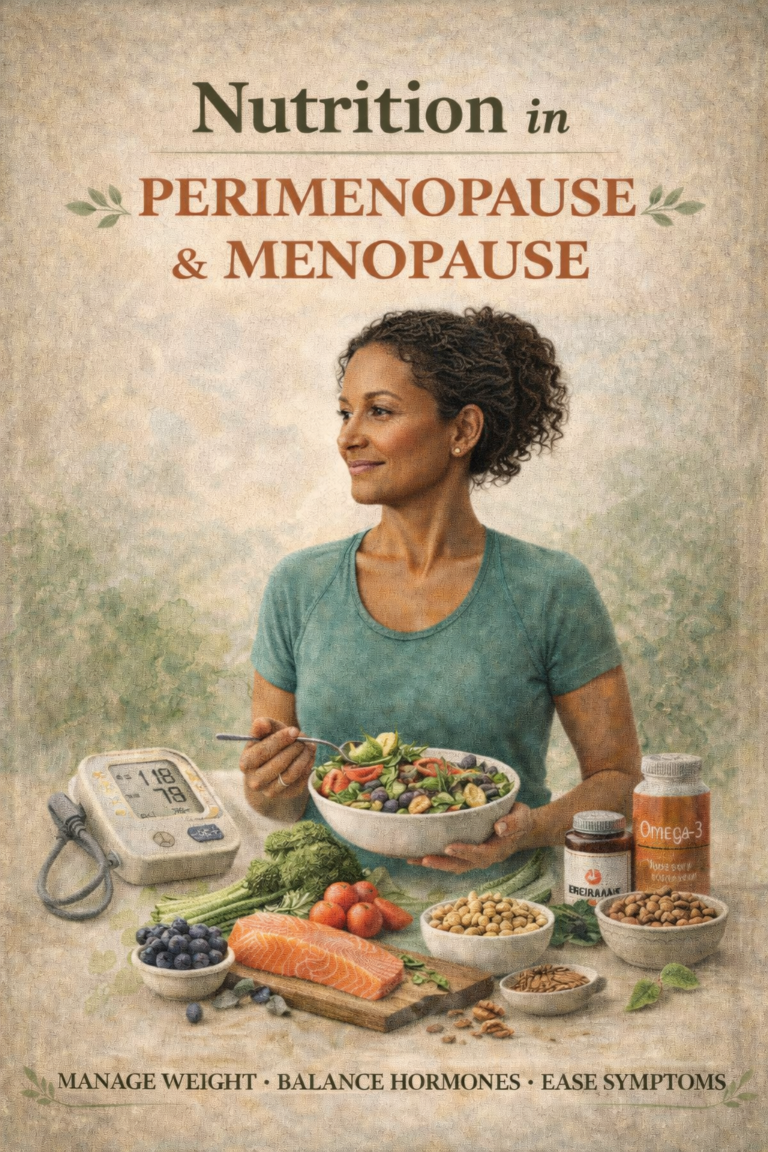
If there’s one area where midlife women are bombarded with conflicting advice, it’s nutrition.
One day it’s:
“Eat less”
“Cut carbs”
“Go keto”
“Try carnivore”
“Fast longer”
“Avoid inflammation at all costs”
And somehow, women are expected to make all of this work while dealing with hormone shifts, poor sleep, stress, and busy lives.
So let’s slow this down and ask the real question:
What does the evidence actually show works for women in perimenopause and menopause?
Spoiler: it’s not a single diet label.
__________________________________________________________________________
First: what changes nutritionally in midlife?
Perimenopause and menopause bring real physiological changes that affect how women respond to food:
Reduced insulin sensitivity (for many, not all)
Loss of estrogen’s protective metabolic effects
Increased cortisol sensitivity
Reduced muscle mass if not actively maintained
Slower recovery from under-eating or over-training
This means strategies that “worked in your 20s” may now backfire.
Nutrition in midlife is less about extremes—and more about precision and consistency.
__________________________________________________________________________
Let’s break down the big nutrition debates
1️⃣ Do calories matter?
Yes.
But not in the simplistic “eat less, move more” way.
Calories matter because:
Chronic calorie deficits impair thyroid function
Under-eating worsens cortisol dysregulation
Muscle loss accelerates when intake is too low
Hormone therapy and exercise become less effective
Many midlife women are under-eating, not overeating—especially protein and total energy.
The goal is not chronic restriction.
The goal is adequate fuel to support muscle, metabolism, and hormones.
2️⃣ Do macronutrients matter?
Absolutely.
But balance matters more than extremes.
Protein: the non-negotiable
Protein is critical for:
Muscle maintenance and growth
Metabolic health
Blood sugar stability
Recovery from exercise
Appetite regulation
Most midlife women need more protein than they think, often:
~1.6–2.2 g/kg body weight
Spread evenly across the day
Protein is not optional in midlife—it’s foundational.
__________________________________________________________________________
Carbohydrates: misunderstood but essential
Carbs are not the enemy.
They support:
Thyroid hormone conversion
Cortisol regulation
Training performance
Sleep quality (via serotonin/melatonin pathways)
Very low-carb diets may be useful short-term for select individuals—but chronically low carbs can worsen:
Fatigue
Sleep
Hormonal symptoms
Exercise tolerance
The right amount depends on:
Activity level
Stress load
Metabolic health
__________________________________________________________________________
Fats: important, but not magic
Dietary fat supports:
Hormone production
Satiety
Nutrient absorption
But high-fat diets alone do not fix hormone imbalance.
Balance matters more than pushing fat excessively high—especially if protein or carbs are sacrificed.
__________________________________________________________________________
What about “anti-inflammatory” diets?
Chronic inflammation does increase with age—but inflammation is not caused by one food group.
Inflammation is driven by:
Poor sleep
Chronic stress
Sedentary behavior
Muscle loss
Blood sugar instability
Gut health issues
An “anti-inflammatory diet” is less about restriction and more about:
Adequate protein
Whole, minimally processed foods
Fiber-rich plants
Omega-3 fats
Consistent fueling
Inflammation improves when the whole system improves.
__________________________________________________________________________
Carnivore, paleo, keto, intermittent fasting—do they work?
These approaches can work…
But usually because they:
Increase protein intake
Reduce ultra-processed foods
Create structure
Improve awareness of eating patterns
They often fail long-term because they:
Are hard to sustain
Increase stress
Reduce food flexibility
Undermine social and emotional health
Lead to under-eating in midlife women
Intermittent fasting, in particular, can:
Worsen cortisol dysregulation
Disrupt sleep
Increase muscle loss if protein is inadequate
Some women do well with gentle time-restricted eating.
Many do not.
There is no universal rule.
__________________________________________________________________________
What the evidence consistently supports
Across nutrition research for midlife women, a few themes are clear:
✅ Adequate total energy
Chronic under-fueling is harmful.
✅ High protein intake
Essential for muscle, metabolism, and aging well.
✅ Resistance training + nutrition together
Diet alone does not preserve muscle.
✅ Blood sugar stability
Consistent meals > extremes.
✅ Sustainability
The “best diet” is one you can follow long-term.
There is no magic macro ratio. There is no perfect eating window. There is no single inflammatory food ruining your hormones.
__________________________________________________________________________
Nutrition does not replace hormones—and hormones do not replace nutrition
This is critical.
Nutrition does not replace HRT when HRT is indicated
HRT does not override poor nutrition
Exercise, diet, hormones, and stress regulation work together
Trying to fix hormones with diet alone is just as ineffective as trying to out-hormone poor lifestyle foundations.
__________________________________________________________________________
The bottom line
For midlife women, what matters most is not the diet label—it’s the physiology it supports.
The most effective nutrition strategy:
Fuels muscle
Supports recovery
Stabilizes blood sugar
Reduces stress
Fits real life
Evolves with your body
Extreme diets are loud.
Foundational nutrition is quiet—but it works.
__________________________________________________________________________
How This Fits Into Care at Antigravity Wellness
At Antigravity Wellness, nutrition is:
Personalized
Evidence-based
Integrated with hormones, movement, and stress physiology
We do not:
Push one “perfect” diet
Ignore calories or protein
Promote chronic restriction
Treat nutrition in isolation
Our goal is not short-term compliance.
It’s long-term strength, metabolic health, and vitality.
__________________________________________________________________________
Are We a Good Fit?
If you’re tired of diet whiplash and ready for:
Clear guidance
Sustainable nutrition
A plan that supports your hormones and your life
👉 Take the Readiness Questionnaire to explore whether our approach aligns with your goals.
__________________________________________________________________________
References
1. Phillips, S. M., et al. (2016).
Dietary protein for athletes: From requirements to optimum adaptation.
Journal of Sports Sciences, 34(6), 537–548. https://pubmed.ncbi.nlm.nih.gov/22150425/
2. Hector, A. J., & Phillips, S. M. (2018).
Protein recommendations for weight loss in elite athletes.
Applied Physiology, Nutrition, and Metabolism, 43(12), 1195–1204. https://pubmed.ncbi.nlm.nih.gov/29182451/
3. Hansen, M., et al. (2011).
Effect of estrogen on muscle protein synthesis.
Journal of Physiology, 589(2), 341–351. https://pubmed.ncbi.nlm.nih.gov/25062001/
4. Ludwig, D. S., et al. (2021).
The carbohydrate–insulin model: A physiological perspective.
American Journal of Clinical Nutrition, 114(6), 1873–1885. https://pmc.ncbi.nlm.nih.gov/articles/PMC8634575/
5. Longo, V. D., & Panda, S. (2016).
Fasting, circadian rhythms, and time-restricted feeding.
Cell Metabolism, 23(6), 1048–1059. https://pubmed.ncbi.nlm.nih.gov/27304506/
6. Calder, P. C. (2017).
Omega-3 fatty acids and inflammatory processes.
Biochimica et Biophysica Acta, 1851(4), 469–484. https://pubmed.ncbi.nlm.nih.gov/22254027/
7. Hall, K. D., et al. (2019).
Ultra-processed diets cause excess calorie intake and weight gain.
Cell Metabolism, 30(1), 67–77. https://pubmed.ncbi.nlm.nih.gov/31105044/
__________________________________________________________________________
Medical Disclaimer
This article is for educational purposes only and does not constitute medical or nutritional advice. Individual needs vary based on health status, medications, and goals. Always consult a qualified healthcare provider before making significant dietary changes.