


“I Didn’t Notice a Problem… Until Everything Overflowed”
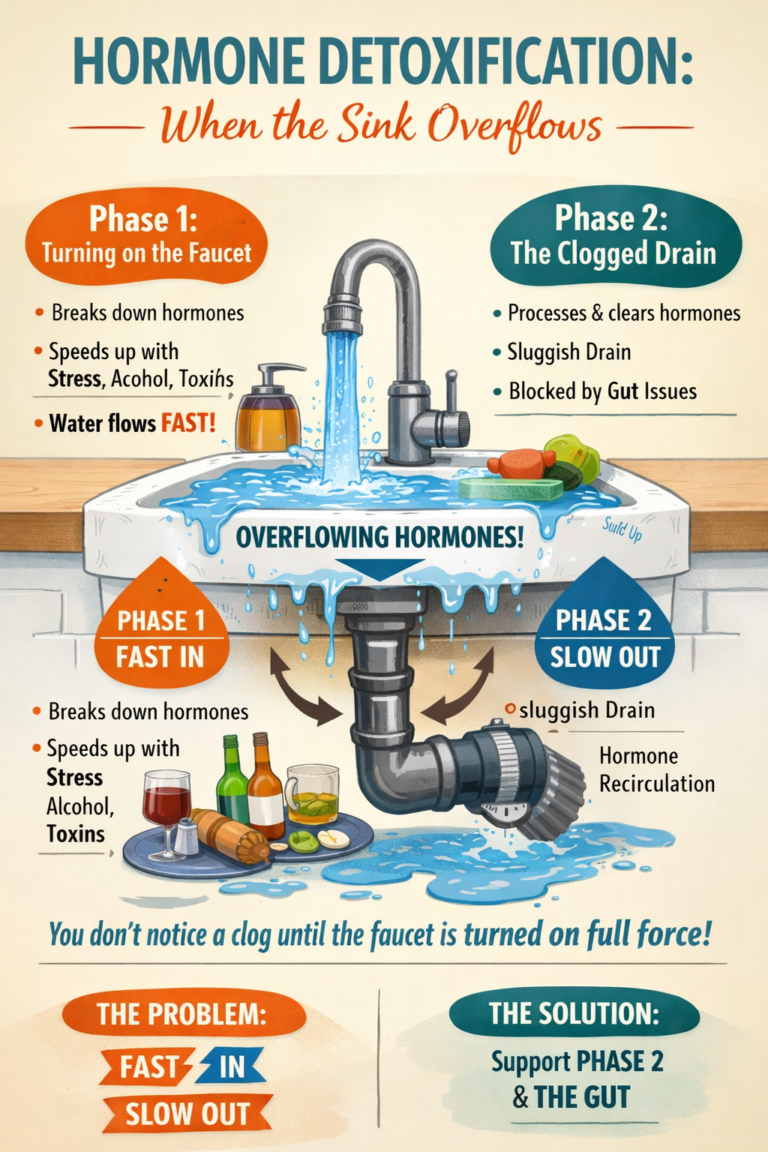
I often explain hormone detoxification to patients like this:
Imagine your kitchen sink.
At first, the drain is a little slow — but nothing seems wrong.
Water still goes down… just not quite as fast.
Then one day, you turn the faucet all the way on.
Suddenly:
- The sink backs up
- Water spills over the edge
- There’s a mess everywhere
- And you’re standing there thinking, “How did this happen so fast?”
That’s exactly how detoxification problems show up in the body.
You don’t notice them when hormone levels are low and steady.
You notice them when hormone production ramps up — like in perimenopause, stress, illness, or hormone therapy.
The problem isn’t the faucet.
The problem is the clogged drain.
What “Detox” Really Means (Not the Internet Version)
Detoxification is not a cleanse, tea, or reset.
It’s the very real, biochemical process your body uses to:
- Break down hormones
- Process medications
- Neutralize toxins
- And get them out of your body
This happens mainly through the liver and the gut, in two main steps:
| Detox Phase | What It Does | Sink Analogy |
| Phase 1 | Breaks hormones & toxins into smaller pieces | Turning on the faucet |
| Phase 2 | Packages them so they can leave the body | The drain working properly |
When Phase 1 runs faster than Phase 2 → overflow happens.
Phase 1 Detox: Turning the Faucet On Faster
Phase 1 detox happens in the liver using enzymes called cytochrome P450 enzymes.
Its job is to:
- Break down estrogen, progesterone, testosterone
- Break down cortisol
- Break down medications and environmental toxins
Here’s the important part most people don’t know:
Phase 1 often speeds up under stress.
Things that speed up Phase 1 detox:
- Chronic stress (high cortisol)
- Alcohol
- Medications
- Environmental toxins
- Inflammation
- Perimenopause hormone fluctuations
- Poor sleep
So now the faucet is wide open.
Hormones are being broken down faster and faster — but if Phase 2 can’t keep up, those partially processed hormones accumulate.
This is why symptoms can appear suddenly and intensely.
Phase 2 Detox: The Drain That Has to Keep Up
Phase 2 detox is where your body:
- Neutralizes hormones
- Makes them water-soluble
- Sends them out through stool and urine
Key Phase 2 pathways include:
- Glucuronidation
- Sulfation
- Methylation
- Glutathione conjugation
Estrogen, progesterone, and testosterone all rely heavily on Phase 2 detox.
If Phase 2 is sluggish:
- Hormones don’t leave
- They recirculate
- Symptoms build even when blood labs look “fine”
Estrogen Detox: Why It Gets the Spotlight
Estrogen gets broken down into different metabolites in Phase 1.
Some are neutral or protective.
Some are more inflammatory.
Phase 2’s job is to escort those metabolites out of the body safely.
When this doesn’t happen efficiently, women may experience:
- Heavy or painful periods
- Breast tenderness
- PMS or PMDD
- Migraines
- Bloating
- Fibroids
- Worsening perimenopause symptoms
This is why women are often told:
“Your estrogen level is normal… but you still feel awful.”
This Applies to Progesterone and Testosterone Too
Estrogen is not the only hormone affected.
- Progesterone relies on Phase 2 pathways for clearance
→ impaired detox can cause bloating, sedation, or mood changes - Testosterone also uses Phase 2
→ impaired clearance can contribute to acne, hair changes, or erratic energy
Detox problems don’t always cause high hormones.
They cause unpredictable hormone signaling.
The Gut: Where Detox Either Finishes… or Fails
After the liver detoxifies hormones, they enter the gut to leave the body.
But if gut health is compromised, hormones can be:
- Reactivated
- Reabsorbed
- Sent back into circulation
Certain gut bacteria produce an enzyme called β-glucuronidase, which can undo estrogen detoxification.
This is why gut issues and hormone symptoms often travel together:
- Constipation
- Bloating
- Dysbiosis
- History of antibiotics
- Inflammation
And this is why stool testing matters.
Why Standard Labs Miss This Entirely
Most conventional labs measure:
- How much hormone is in the blood
They do not measure:
- How hormones are broken down
- Whether detox pathways are overloaded
- Whether hormones are being reabsorbed through the gut
This is where functional testing becomes essential.
The Functional Testing We Use at Antigravity Wellness
DUTCH Testing
The DUTCH test allows us to see:
- Estrogen metabolites
- Phase 1 and Phase 2 detox patterns
- Cortisol rhythm
- Progesterone and androgen metabolism
This shows us how hormones are being handled, not just how much you have.
Functional Gut Testing
We use functional gut testing to assess:
- Microbial balance
- Inflammation
- Digestive function
- Detox support capacity
Because no single test fits every patient, we choose testing based on your symptoms and history.
Case Study: When the Sink Overflowed
Patient: 46-year-old woman, busy professional, two kids
Symptoms:
- Severe breast tenderness
- Migraines before her period
- Bloating and constipation
- Increasing anxiety
- “Estrogen intolerance” despite normal labs
She told me:
“It feels like my body just can’t handle hormones anymore. Every month I’m bracing for impact.”
Standard labs:
- Estrogen: “normal”
- Progesterone: “normal”
Functional testing showed:
- Phase 1 estrogen metabolism running fast
- Sluggish Phase 2 clearance
- Signs of estrogen reactivation in the gut
- Irregular cortisol rhythm amplifying the problem
Her faucet was wide open.
Her drain was clogged.
Our approach:
- Supported Phase 2 detox pathways
- Addressed gut health and elimination
- Reduced Phase 1 overload
- Adjusted nutrition and lifestyle strategically
A few weeks later, she said:
“For the first time in years, my cycle came and went without knocking me off my feet. I didn’t even realize how bad it had gotten until it wasn’t anymore.”
How Antigravity Wellness Helps
At Antigravity Wellness, we don’t just ask:
“What are your hormone levels?”
We ask:
- How are your hormones being metabolized?
- How are they being cleared?
- Is your gut allowing detox to finish?
If you live in Washington or Oregon and want to see if we’re a good fit, the first step is our Readiness Questionnaire.
This helps us determine:
- Whether functional testing is appropriate
- What level of care makes sense for you
- Whether our approach aligns with your goals
👉 Take the Readiness Questionnaire
The Takeaway
You don’t notice a clogged drain until the faucet is turned on full force.
Perimenopause, stress, illness, and hormone therapy all turn the faucet on.
Supporting detoxification — especially Phase 2 and the gut — is often the missing piece for women who feel dismissed, frustrated, and stuck.
Medical Disclaimer
This article is for educational purposes only and does not replace medical advice. Always consult a qualified healthcare provider before making changes to medications, supplements, or treatment plans.
References
- Conney AH. Induction of microsomal enzymes and detoxification. Cancer Research. https://garfield.library.upenn.edu/classics1979/A1979HZ31900001.pdf
- P Muti. Estrogen metabolism and risk of breast cancer. https://pubmed.ncbi.nlm.nih.gov/11055622/
- Maryann Kwa. The Intestinal Microbiome and Estrogen Receptor. https://pubmed.ncbi.nlm.nih.gov/27107051/
- Saqib Hassan. Endocrine disruptors: Unravelling the link between chemical exposure and Women’s reproductive health. https://www.sciencedirect.com/science/article/abs/pii/S0013935123021898
- Phase II detoxification. https://www.geneticlifehacks.com/detox/phase-ii-detoxification/
- Precision Analytical Inc. DUTCH Test Clinical Reference Materials. https://dutchtest.com/