

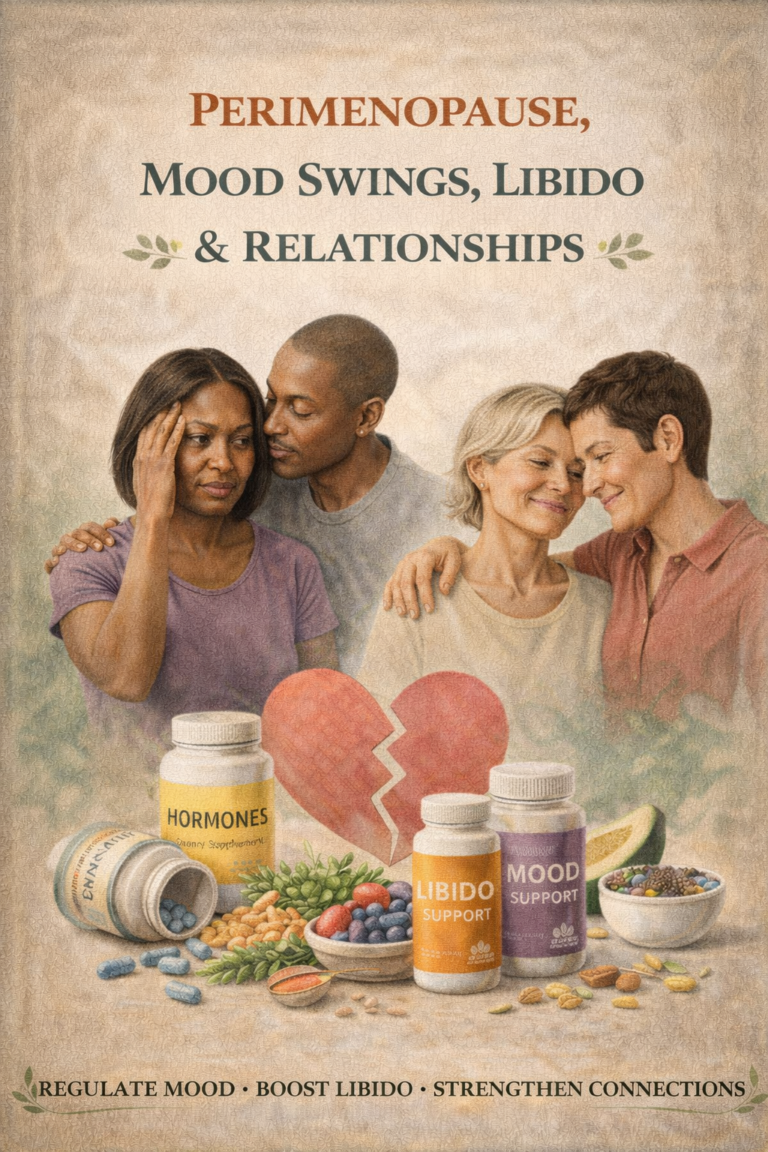
A Midlife Story You Might Recognize
She loves her partner.
But lately, she snaps over small things. She cries more easily. She feels tired and touched-out. Sex feels complicated—or nonexistent. Then comes the guilt: “What’s wrong with me?”
Nothing is “wrong.”
This is perimenopause—and it can change how you feel, think, and connect with the people you love.
What Is Perimenopause? (In Simple Terms)
Perimenopause is the transition time before menopause. It often starts in the late 30s or 40s and can last several years.
During this time, key hormones change:
- Estrogen – helps the brain manage mood and emotions
- Progesterone – helps calm the nervous system and support sleep
- Testosterone – supports energy, confidence, and libido (sexual desire)
When these hormones go up and down, it affects:
- 😔 Mood
- 🔥 Libido
- 💬 Communication
- ❤️ Relationships
This is biology, not a personal failure.
How Hormone Changes Affect Relationships
1. Mood Swings & Emotional Reactivity
When estrogen and progesterone drop:
- Emotions feel bigger
- Stress feels heavier
- Patience gets thinner
You may:
- React faster
- Feel misunderstood
- Feel bad afterward
This happens because your nervous system (the brain-body stress system) is more sensitive.
2. Libido Changes (Very Common)
Low libido is one of the most common perimenopause symptoms.
Why desire drops:
- Lower testosterone
- Poor sleep
- High cortisol (stress hormone)
- Mental overload
Important truth:
Libido doesn’t disappear—it changes.
Many women move from spontaneous desire (it just shows up) to responsive desire (it comes after safety, rest, and connection).
3. Communication Breakdowns
When you feel off inside your body, it’s harder to explain what you need.
Partners may:
- Feel confused
- Feel rejected
- Take things personally
Clear, simple language helps:
“My hormones are changing, and I’m learning what my body needs. I want us on the same team.”
This removes blame and builds teamwork.
A Real-Life Case Study
Sarah, age 44, came to us feeling disconnected from her partner.
She had:
- Mood swings
- Low libido
- Poor sleep
- Constant guilt
She thought her relationship was failing.
After proper hormone testing and support:
- Her sleep improved
- Her mood stabilized
- Desire slowly returned
- Communication felt easier
The relationship wasn’t broken—her hormones were asking for support.
How Antigravity Wellness Helps
We don’t guess. We test, teach, and support.
Our care packages focus on:
- 🧪 Functional hormone testing (when appropriate)
- 🥗 Nutrition to support brain and hormone health
- 💊 Targeted supplements
- 🧠 Stress and nervous system regulation
- ❤️ Libido and relationship education
- 🤝 Ongoing coaching and support
We care for the whole woman, not just symptoms.
Your First Step: The Readiness Questionnaire
The best place to start is our Readiness Questionnaire.
It helps us understand:
- Your symptoms
- Your goals
- What level of support is right for you
👉 Take the Readiness Questionnaire here
No pressure. Just clarity.
You’re Not Alone
Perimenopause can strain relationships—but it can also deepen them.
With understanding, support, and the right care, this season can become a reset, not a breaking point.
Medical References
- The Menopause Society. Perimenopause. https://menopause.org/patient-education/menopause-topics/perimenopause
- Santoro N, et al. Endocrine Reviews – Hormonal changes in the menopause transition. https://pubmed.ncbi.nlm.nih.gov/33095879/
- Maurand Cappelletti. Increasing women’s sexual desire. https://pmc.ncbi.nlm.nih.gov/articles/PMC4720522/
- Freeman EW. Menopause – Mood changes and depression during perimenopause. https://pubmed.ncbi.nlm.nih.gov/16585466/
- Clayton AH, et al. Obstetrics & Gynecology Clinics – Testosterone and female sexual function. https://pubmed.ncbi.nlm.nih.gov/14563102/
Medical DisclaimerThis blog is for educational purposes only and does not replace medical advice, diagnosis, or treatment. Always consult a qualified healthcare provider before starting or changing any medical, hormone, supplement, or lifestyle plan.