If there’s one topic surrounded by confusion, half-truths, and outdated advice for women in midlife, it’s building muscle.
Women are told:
“Lift light weights”
“Do more reps”
“Don’t go too heavy”
“Just walk more”
“Hormones make it impossible anyway”
None of that is supported by good science.
The truth is this:
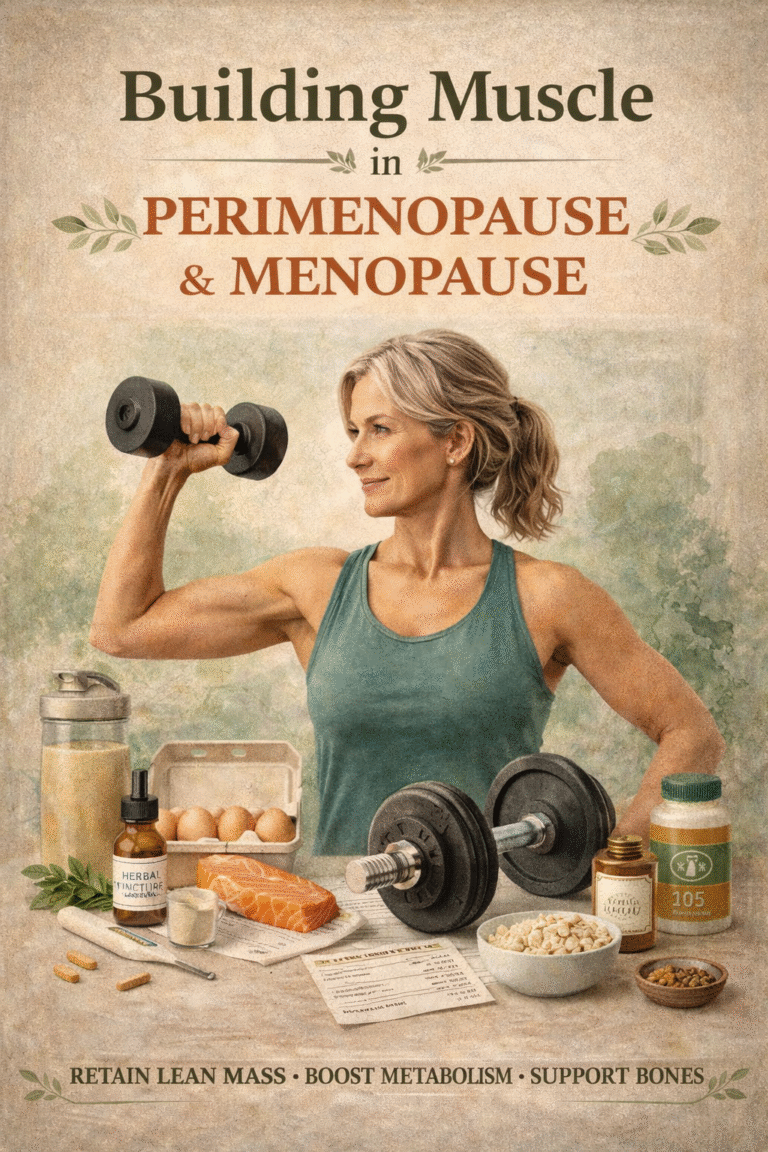
Building and maintaining muscle in perimenopause and menopause is absolutely possible—and it is one of the most powerful medical interventions we have for women in midlife and beyond.
Whether you are on hormone replacement therapy (HRT) or not, strength training is non-negotiable for long-term health, independence, and vitality.
Let’s break down what the research actually says.
____________________________________________________________________________
First: Why muscle matters more than ever in midlife
After age 30, women begin to lose muscle mass gradually.
During perimenopause and menopause, that loss can accelerate due to:
Declining and fluctuating estrogen
Reduced anabolic signaling
Increased insulin resistance
Higher inflammation
Reduced recovery capacity
Loss of muscle (sarcopenia) is associated with:
Increased fracture risk
Insulin resistance and diabetes
Weight gain and fat redistribution
Loss of strength, balance, and independence
Higher all-cause mortality
This is why muscle is not an aesthetic goal.
It’s a longevity and health goal.
____________________________________________________________________________
The big question: what actually builds muscle?
Muscle growth (hypertrophy) comes down to a few key, evidence-based drivers:
1️⃣ Mechanical tension (this is the secret sauce)
Mechanical tension—lifting loads that challenge the muscle—is the primary stimulus for muscle growth.
Not:
Sweat
Burn
Exhaustion
Heart rate
But tension placed on muscle fibers.
This means:
You must lift weights that feel challenging
The muscle needs to be close to fatigue
The last few reps should feel difficult (but controlled)
Light weights that never challenge you will not build muscle—especially in midlife.
2️⃣ Progressive overload (you must keep asking more of the muscle)
Muscle only grows when it’s asked to do more than it’s already adapted to.
Progressive overload can look like:
Increasing weight
Increasing reps at the same weight
Increasing sets
Improving control and tempo
Reducing rest time strategically
If nothing progresses, muscle growth stalls—regardless of age or hormones.
3️⃣ Volume matters—but more is not always better
Training volume = total sets × reps × load.
Research suggests that for most women:
10–20 hard sets per muscle group per week is effective
Sets should be taken close to muscular fatigue
Junk volume (too many easy sets) does not count
In perimenopause and menopause, recovery matters more than in your 20s.
More volume is not better if:
Sleep is poor
Stress is high
Nutrition is inadequate
Consistency beats annihilation.
4️⃣ Rep ranges: stop obsessing over the “perfect” number
Here’s the good news: Muscle can be built across a wide rep range.
Research shows hypertrophy occurs with:
Lower reps (5–8) with heavier loads
Moderate reps (8–12)
Higher reps (12–20+) if taken close to failure
The key is not the rep number.
The key is effort and proximity to fatigue.
For most midlife women, a mix works best:
Moderate reps for joint health and recovery
Some heavier work to preserve strength and bone density
5️⃣ Intensity: it matters, but it must be intelligent
Intensity means how hard the set is, not how exhausted you feel.
Effective hypertrophy training typically involves:
Leaving 0–3 reps “in reserve”
Challenging sets that require focus
Good form and control
Constant HIIT, bootcamp-style workouts:
Elevate stress hormones
Impair recovery
Do not provide enough mechanical tension
Often worsen symptoms in perimenopause
Hard ≠ effective.
____________________________________________________________________________
What about hormones and HRT?
Estrogen supports muscle—but it’s not magic
Estrogen helps with:
Muscle repair
Satellite cell activation
Recovery
Insulin sensitivity
As estrogen declines, muscle becomes less responsive, meaning:
Training stimulus needs to be stronger
Recovery needs to be prioritized
Nutrition becomes critical
HRT can help—but it does not replace training
Hormone therapy may:
Improve recovery
Support lean mass retention
Enhance training response
But HRT does not build muscle by itself.
And strength training:
Does not replace HRT
Does not negate the need for HRT
Works synergistically with it
These are complementary tools, not substitutes.
____________________________________________________________________________
Nutrition: the silent deal-breaker
You cannot build muscle without:
Adequate protein
Sufficient calories
Proper nutrient timing
General guidelines for midlife women:
Protein: ~1.6–2.2 g/kg body weight (often higher than women expect)
Protein spread throughout the day
Carbohydrates to support training and recovery
Under-eating is one of the most common reasons women fail to gain muscle in midlife.
____________________________________________________________________________
Recovery: the overlooked variable in perimenopause
Muscle is built during recovery, not during the workout.
Midlife women need:
Quality sleep
Rest days
Stress management
Nervous system regulation
Training harder while recovering worse is not a winning strategy.
____________________________________________________________________________
The bottom line
There is no secret trick.
The “secret sauce” for building muscle in perimenopause and menopause is:
Progressive resistance training
Sufficient intensity and mechanical tension
Adequate volume (not excessive)
Enough protein and calories
Recovery that matches the stress load
This applies:
Whether you are on HRT or not
Whether your goal is strength, health, or aesthetics
Whether you are 40 or 70
Muscle is medicine.
And strength training is not optional—it is foundational to women’s health, longevity, and independence.
____________________________________________________________________________
How This Fits Into Care at Antigravity Wellness
At Antigravity Wellness, we view strength training as:
A core medical intervention
A pillar of hormone health
Essential for metabolic and bone health
Non-negotiable in midlife care
Hormones, nutrition, movement, recovery, and stress physiology all work together.
We do not:
Replace strength training with hormones
Replace hormones with exercise
Treat one system in isolation
We build the whole woman—strong, resilient, and capable.
____________________________________________________________________________
Are We a Good Fit?
If you’re ready to:
Stop fearing weights
Build muscle intentionally
Support your hormones and long-term health
Learn how to train for your season of life
The next step is clarity.
👉 Take the Readiness Questionnaire to see if our approach aligns with your goals.
____________________________________________________________________________
References
1. Phillips, S. M., & Winett, R. A. (2010).
Uncomplicated resistance training and health-related outcomes.
Sports Medicine, 40(9), 703–721. https://pubmed.ncbi.nlm.nih.gov/20622538/
2. Morton, R. W., et al. (2016).
Neither load nor systemic hormones determine resistance training–mediated hypertrophy.
Journal of Applied Physiology, 121(1), 129–138. https://pubmed.ncbi.nlm.nih.gov/27174923/
3. Schoenfeld, B. J. (2010).
The mechanisms of muscle hypertrophy and their application to resistance training.
Journal of Strength and Conditioning Research, 24(10), 2857–2872. https://pubmed.ncbi.nlm.nih.gov/20847704/
4. Schoenfeld, B. J., et al. (2017).
Resistance training volume enhances muscle hypertrophy.
Medicine & Science in Sports & Exercise, 49(3), 527–534. https://pubmed.ncbi.nlm.nih.gov/30153194/
5. Hansen, M. (2018).
Female hormones: Do they influence muscle and tendon protein metabolism?
Proceedings of the Nutrition Society, 77(1), 32–41. https://pubmed.ncbi.nlm.nih.gov/28847313/
6. Daly, R. M., et al. (2019).
Exercise for the prevention of osteoporosis in postmenopausal women.
Current Osteoporosis Reports, 17(5), 332–339. https://pmc.ncbi.nlm.nih.gov/articles/PMC6429007/
7. Moore, D. R., et al. (2012).
Protein ingestion to stimulate myofibrillar protein synthesis.
Journal of Applied Physiology, 113(3), 411–419. https://pubmed.ncbi.nlm.nih.gov/25056502/
____________________________________________________________________________
Medical Disclaimer
This article is for educational purposes only and does not constitute medical, nutritional, or exercise advice. Individual needs vary. Always consult a qualified healthcare provider before beginning or modifying an exercise, nutrition, or hormone therapy program.