Many women come to us saying some version of this:
> “No matter what I eat, I’m bloated.”
“I’ve tried every diet and nothing helps my gut.”
“I eat ‘clean,’ but I never feel well.”
And often, one of the biggest missing pieces isn’t protein, carbs, or supplements.
It’s something humans relied on for thousands of years—and that modern diets have almost completely erased:
Probiotic (fermented) foods.
These aren’t trendy add-ons. They’re a core part of human evolution and gut health—and their absence plays a major role in dysbiosis, bloating, inflammation, and hormone-related GI symptoms, especially in perimenopause and menopause.
___________________________________________________________________________
What are probiotic foods—and why did we evolve with them?
Probiotic foods are living foods created through fermentation that naturally contain beneficial microorganisms.
Historically:
Food was fermented for preservation
Humans consumed live bacteria daily
The gut microbiome evolved with these foods
Today, the Standard American Diet is:
Highly processed
Low in microbial diversity
Often sterile by design
Nearly devoid of fermented foods
The result is a gut ecosystem that’s under-nourished and fragile, particularly as women enter midlife.
___________________________________________________________________________
Why probiotic foods matter more in perimenopause & menopause
Estrogen and the gut are deeply connected
As estrogen fluctuates and declines:
Gut motility slows
Microbial diversity decreases
Gut barrier integrity weakens
Estrogen metabolism becomes less efficient
Inflammation increases
There is even a specific collection of gut bacteria—the estrobolome—responsible for metabolizing and recycling estrogen.
When probiotic intake is low:
Estrogen clearance worsens
Hormone symptoms intensify
Bloating, constipation, and diarrhea become more common
This is one reason many women notice new or worsening gut symptoms in midlife, even if their diet hasn’t changed much.
___________________________________________________________________________
Common probiotic foods (and how to use them)
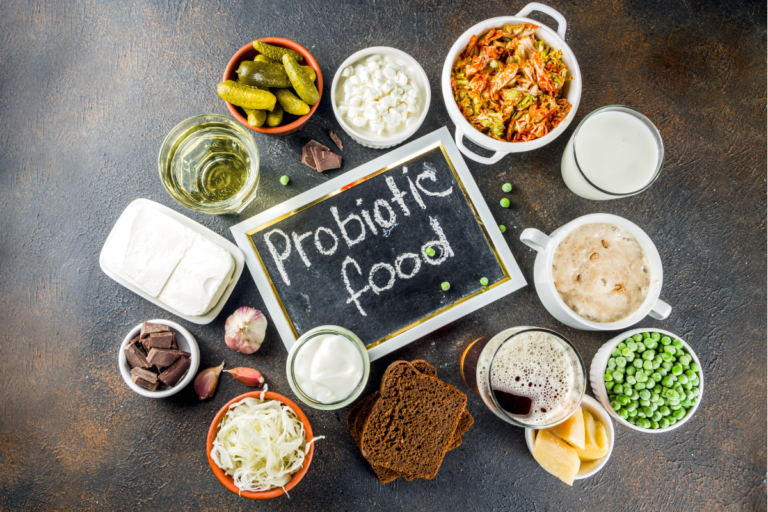
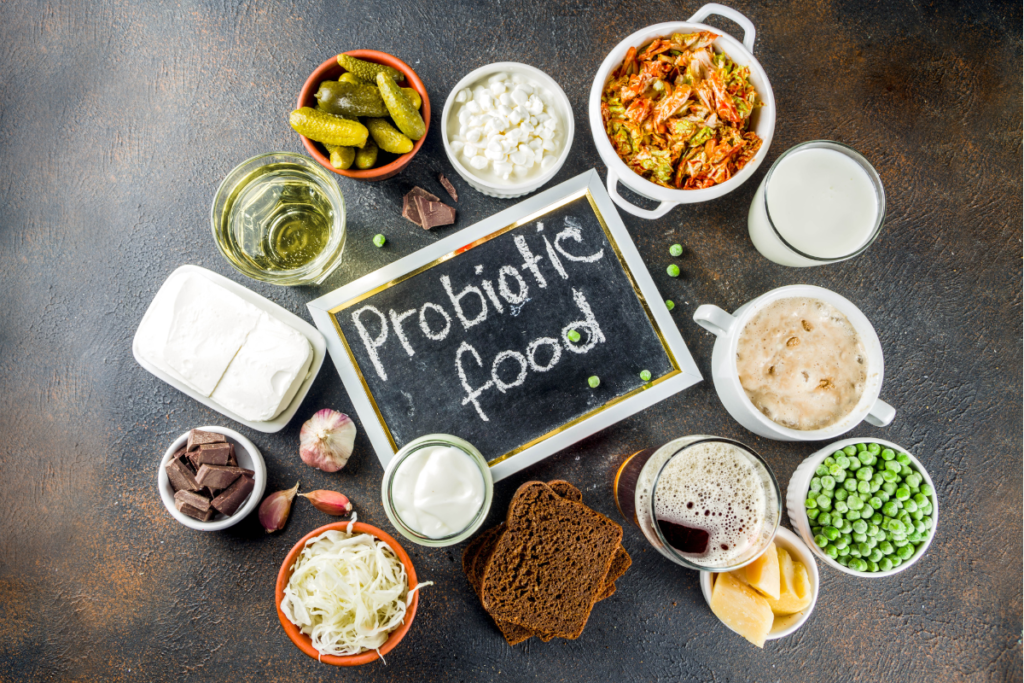
Some of the most accessible probiotic foods include:
Sauerkraut (unpasteurized)
Kimchi
Kefir (dairy-free options count)
Yogurt with live cultures (dairy-free options ok)
Miso
Tempeh
Kombucha (low sugar, in moderation)
Naturally fermented pickled vegetables (not vinegar-only)
Key point:
Small, consistent amounts matter far more than large, occasional servings.
Think forkfuls, not bowls.
___________________________________________________________________________
How to safely incorporate probiotic foods
If your gut is relatively stable, start gently:
General guidelines
Start with 1–2 tablespoons per day
Increase slowly over 1–2 weeks
Rotate types for microbial diversity
Pair with meals (easier on digestion)
Simple ways to include them
Add sauerkraut to eggs or bowls
Use miso in soups or dressings
Blend kefir into smoothies
Serve kimchi alongside protein and veggies
Snack on yogurt with berries and seeds
Consistency beats intensity.
___________________________________________________________________________
A sample probiotic-supportive day of eating
Breakfast
Eggs with sautéed vegetables
Side of sauerkraut (1–2 Tbsp)
Lunch
Protein + large salad
Olive oil dressing
Fermented pickles or kimchi (1–2 Tbsp)
Snack
Dairy-free yogurt with berries and chia seeds
Dinner
Protein + roasted vegetables
Miso-based sauce or soup
This approach feeds the gut gently while supporting hormone health.
___________________________________________________________________________
When probiotic foods may NOT be appropriate (important)
Some women feel worse, not better, with fermented foods—and that’s not failure. It’s information.
Probiotic foods may need to be limited or paused if you have:
Suspected or confirmed SIBO
Active gut infections
Significant bloating shortly after eating fermented foods
Histamine intolerance
Mast cell activation symptoms
In these cases, adding more bacteria can worsen symptoms until underlying issues are addressed.
This is why one-size-fits-all advice doesn’t work.
___________________________________________________________________________
Where do probiotic supplements fit in?
This is one of the most common questions we get:
“If probiotic foods are so important, should I also take a probiotic supplement?”
The honest answer:
Food should be the foundation
Supplements can be helpful in specific situations
Most probiotics on the market do very little
Our ancestors didn’t take probiotic capsules.
They ate fermented foods daily.
Supplements are a modern tool, not a replacement for living foods.
___________________________________________________________________________
When probiotic supplements can be helpful
Probiotic supplements may be useful when:
You don’t yet tolerate probiotic foods
You’re recovering from antibiotic use
Functional gut testing shows dysbiosis
You’re in a targeted gut-healing phase
You need short-term support while rebuilding tolerance
In these cases, quality matters.
___________________________________________________________________________
The problem with most probiotic supplements
Many probiotics:
Don’t survive stomach acid
Don’t colonize the gut
Only work while you’re taking them
Lead to symptoms returning once stopped
That’s not gut healing—that’s temporary symptom control.
___________________________________________________________________________
A probiotic we actually see work in practice
One probiotic we frequently use and trust at Antigravity Wellness is Seed.
Why it stands out:
Clinically studied strains
Designed to survive digestion
Includes both prebiotic + probiotic components
Demonstrates colonization, not just temporary effects
We’ve seen not only symptom improvement, but sustained changes on repeat functional gut testing—which is rare in this space.
___________________________________________________________________________
But this is critical: supplements are not the goal
Even with high-quality options, we are very clear:
> Do not rely on probiotic supplements as your long-term gut strategy.
They are:
A bridge
A support
A tool during healing
They are not how humans evolved to maintain gut health.
The long-term goal is food-based microbial diversity.
___________________________________________________________________________
Probiotic supplements are not always appropriate
Just like fermented foods, supplements can worsen symptoms if:
SIBO is present
Active infections haven’t been treated
Histamine intolerance is significant
Sometimes the right answer is:
> “Not yet—let’s fix the terrain first.”
That restraint is part of good medicine.
___________________________________________________________________________
Why functional gut testing matters
At Antigravity Wellness, when symptoms persist despite good foundations, we often use functional gut testing to gain clarity.
Testing can reveal:
Bacterial imbalances
Yeast or fungal overgrowth
Parasitic infections
Inflammatory markers
Digestive enzyme function
Gut immune activity
This helps us determine:
Whether foundational support is enough
Whether targeted protocols are needed
Whether next-level testing or treatment is appropriate
This isn’t about being aggressive—it’s about being precise.
___________________________________________________________________________
Foundations still come first (always)
No supplement or protocol replaces:
Adequate protein
Adequate fiber
Hydration
Sleep
Strength training
Stress and nervous system regulation
Prebiotic + probiotic foods (when appropriate)
Supplements build on foundations—they don’t replace them.
___________________________________________________________________________
The big picture
Probiotic foods are not optional extras. They are part of our biological design.
Removing them from the diet—and then wondering why the gut struggles, especially during perimenopause—is not a mystery.
When used thoughtfully:
Probiotic foods support hormone metabolism
Improve digestion
Reduce inflammation
Strengthen the gut–brain axis
Increase resilience in midlife
But timing, context, and individual physiology matter.
___________________________________________________________________________
How This Fits Into Care at Antigravity Wellness
At Antigravity Wellness, we:
Individualize gut support
Respect symptom signals
Use food first, supplements strategically
Test when needed
Avoid symptom suppression without understanding why
We don’t just ask what you’re eating—we ask how your body is responding.
___________________________________________________________________________
Are We a Good Fit?
If you’re dealing with:
Chronic bloating or gas
Long-standing constipation or diarrhea
Food sensitivities that keep expanding
Hormone-related digestive changes
👉 Take the Readiness Questionnaire to explore whether our whole-person approach aligns with your needs.
WA and OR state residents only due to licensing requirements.
___________________________________________________________________________
References
1. Marco, M. L., et al. (2017).
Health benefits of fermented foods. https://pubmed.ncbi.nlm.nih.gov/27998788/
3. Cryan, J. F., et al. (2019).
The microbiota–gut–brain axis.
Physiological Reviews, 99(4), 1877–2013. https://pubmed.ncbi.nlm.nih.gov/31460832/
4. Santos-Marcos, J. A., et al. (2018).
Gut microbiota changes in menopause.
Maturitas, 117, 25–31. https://www.sciencedirect.com/science/article/abs/pii/S0378512218302639
5. Hill, C., et al. (2014).
Expert consensus on probiotics.
Nature Reviews Gastroenterology & Hepatology, 11(8), 506–514. https://pubmed.ncbi.nlm.nih.gov/24912386/
___________________________________________________________________________
Medical Disclaimer
This article is for educational purposes only and does not constitute medical, nutritional, or supplement advice. Individual needs vary based on health status, medications, and symptoms. Always consult a qualified healthcare provider before making dietary or supplement changes.