For women who are still having menstrual cycles, one of the most frustrating parts of perimenopause is this:
“My PMS keeps getting worse—even though I haven’t changed anything.”
Mood swings, breast tenderness, bloating, cramps, sleep issues, anxiety, sugar cravings—often all intensify as hormones become more erratic, not absent.
Here’s the good news:
There’s a very simple, food-based strategy I use frequently with cycling patients that can make a surprisingly big difference—especially for PMS.
It’s called seed cycling.
It’s not a cure-all.
It doesn’t replace medical care when needed.
But for the right woman, it can be a sneaky-effective first lever to pull before escalating to more aggressive measures.
____________________________________________________________________________
What is seed cycling?
Seed cycling is a whole-food nutrition strategy that uses specific seeds during different phases of the menstrual cycle to support hormone metabolism and balance.
It works by:
Providing key micronutrients needed for hormone production
Supporting estrogen metabolism and progesterone support
Gently influencing the gut–hormone connection
Reducing inflammatory load during vulnerable phases
This is not about forcing hormones.
It’s about giving the body the raw materials it needs to regulate itself better.
____________________________________________________________________________
Why seed cycling works especially well in perimenopause
In perimenopause:
Estrogen becomes chaotic, not simply low
Progesterone often declines earlier and faster
Ovulation becomes less reliable
PMS symptoms intensify as the estrogen-to-progesterone ratio shifts
Seed cycling helps by:
Supporting estrogen clearance early in the cycle
Providing nutrients that support progesterone production and calming in the luteal phase
Feeding the gut bacteria involved in hormone metabolism
Reducing inflammatory signaling that worsens PMS symptoms
This is why it often works best for worsening PMS, not for women who have already stopped cycling.
____________________________________________________________________________
The four seeds used in seed cycling (and why)
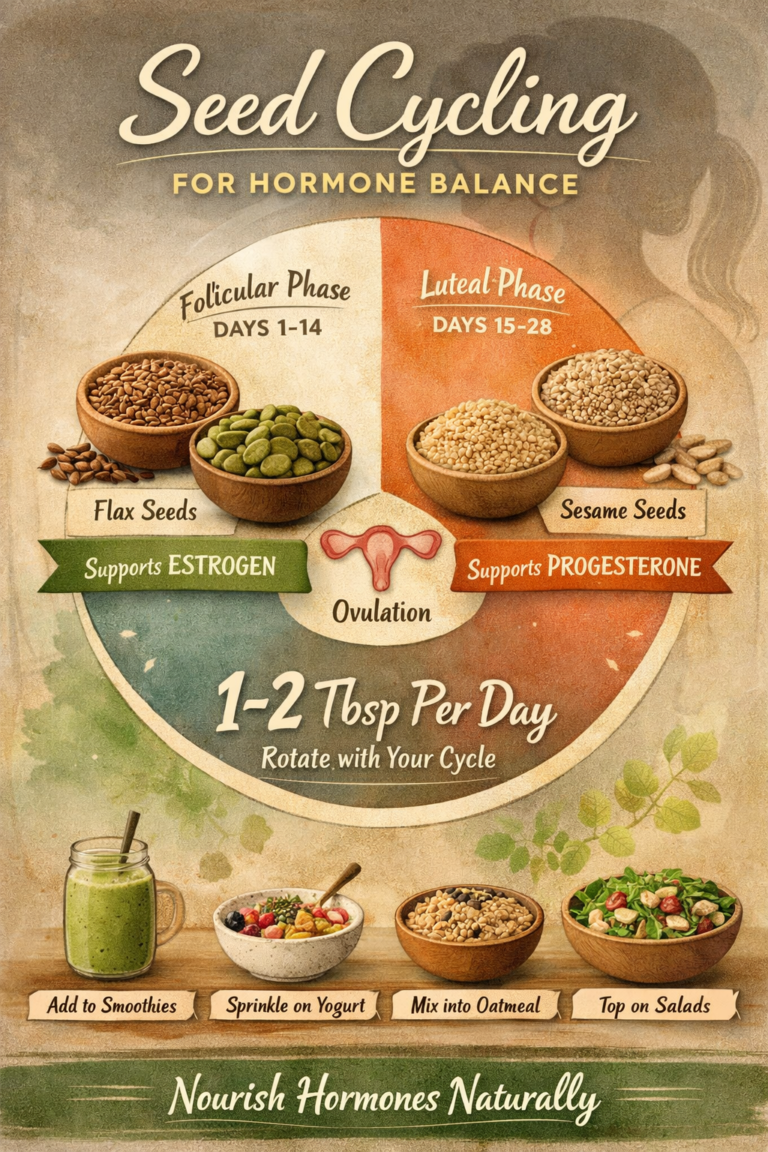
Follicular Phase (Day 1 → Ovulation)
Flaxseed + Pumpkin seeds
These support:
Estrogen metabolism and clearance
Liver and gut detox pathways
Zinc intake (important for ovulation and immune health)
Fiber for hormone elimination
Flaxseed also provides lignans, which help modulate estrogen activity.
____________________________________________________________________________
Luteal Phase (Ovulation → Period)
Sesame seeds + Sunflower seeds
These support:
Progesterone production
Magnesium and vitamin B6 intake
Anti-inflammatory fatty acids
Nervous system calming
This phase is where PMS symptoms typically show up—and where many women feel the biggest shift with seed cycling.
____________________________________________________________________________
How much do you actually need?
This is the part women love:
👉 Only 1–2 tablespoons per day total
That’s it.
You are not eating cups of seeds.
You are replenishing micronutrients consistently, not overwhelming your digestion.
More is not better here.
____________________________________________________________________________
How long does seed cycling take to work?
This is not instant.
Most women notice:
Subtle changes after 1 cycle
Clear improvement after 2–3 cycles
Best results with consistent use for 3 months
Why? Because hormones respond to patterns over time, not one-off interventions.
Consistency beats intensity.
____________________________________________________________________________
How to make seed cycling stupid-simple (this is the key)
The reason most women quit seed cycling is overcomplication.
So here’s how to make it effortless:
Step 1: Pre-mix two blends
Follicular Phase Blend
Ground flaxseed
Ground pumpkin seeds
Store in an airtight jar.
Luteal Phase Blend
Ground sesame seeds
Ground sunflower seeds
Store in a separate jar.
Grinding matters—whole seeds often pass through undigested.
____________________________________________________________________________
Step 2: Use 1–2 tablespoons per day
That’s it.
No measuring stress. No perfection required.
____________________________________________________________________________
Step 3: Add to foods you already eat
Easy options:
Smoothies
Yogurt (dairy-free works)
Oatmeal or chia pudding
Sprinkled on salads
Mixed into nut butter
Added to soups or bowls
You don’t need a “special seed cycling recipe.”
____________________________________________________________________________
Who seed cycling is best for
Seed cycling is especially helpful for women who:
Are still cycling (even irregularly)
Have worsening PMS
Notice mood, sleep, or anxiety changes pre-period
Want a food-first approach
Are not ready (or do not yet need) hormone therapy
It’s often a beautiful bridge strategy.
____________________________________________________________________________
Who seed cycling may NOT be enough for
Seed cycling may not fully address symptoms if there is:
Significant progesterone deficiency
Thyroid dysfunction
Severe estrogen dominance
Chronic anovulation
Gut dysbiosis affecting hormone metabolism
In these cases, seed cycling can still be supportive—but it won’t replace proper evaluation and treatment.
This is why we don’t stop at food when symptoms persist.
____________________________________________________________________________
Why this works: micronutrients matter
Seeds provide:
Zinc
Magnesium
Vitamin B6
Selenium
Fiber
Anti-inflammatory fats
These are nutrients many women are quietly deficient in, especially as stress increases and absorption declines in midlife.
Sometimes the body doesn’t need a prescription.
It needs raw materials—consistently.
____________________________________________________________________________
How This Fits Into Care at Antigravity Wellness
At Antigravity Wellness, seed cycling is:
One tool—not the whole toolbox
Often used early for PMS support
Paired with nutrition, stress regulation, and gut health
Reassessed if symptoms persist
We don’t jump straight to “do nothing” or “do everything.”
We choose the right lever at the right time.
____________________________________________________________________________
Are We a Good Fit?
If you’re still cycling and noticing:
PMS getting worse, not better
Mood or sleep changes before your period
Increased bloating or breast tenderness
Feeling dismissed or told “it’s normal”
👉 Take the Readiness Questionnaire to see if our approach aligns with what your body is asking for.
Available for WA & OR state residents only due to licensing requirements.
____________________________________________________________________________
The Bottom Line
Seed cycling is not trendy—it’s practical.
It’s:
Simple
Affordable
Food-based
Low risk
Surprisingly effective for the right woman
Sometimes, restoring balance doesn’t require more intervention—
just better inputs.
And whole foods, used intentionally, can be incredibly powerful 🌱
____________________________________________________________________________
References
Important note on the evidence: “Seed cycling” as a named protocol has limited high-quality clinical trial data. Most of what we can support from medical literature is the mechanism (fiber, lignans, micronutrients) and ingredient-level evidence (e.g., flax and sesame effects on estrogen metabolism; magnesium + B6 for PMS). The clinical use is common and often helpful, but the research base is still emerging.
Seed cycling / integrative evidence (emerging)
1. Nagarajan DR, et al. (2025). Efficacy of Seed Cycling as an Integrative Therapy. https://pmc.ncbi.nlm.nih.gov/articles/PMC12461132/
2. Dhamija P, et al. (2025). Seed cycling and hormonal balance: A case study. https://pubmed.ncbi.nlm.nih.gov/40511049/
3. ClinicalTrials.gov (registered study). Impact of Seed Cycling on Menstrual Regularity. https://clinicaltrials.gov/study/NCT07052500
4. Brooks JD, et al. (2004). Supplementation with flaxseed alters estrogen metabolism in postmenopausal women… American Journal of Clinical Nutrition. https://pubmed.ncbi.nlm.nih.gov/14749240/
5. Chang VC, et al. (2019). Effect of dietary flaxseed intake on circulating… (lignan-related hormonal pathways; review/mechanistic context). https://pubmed.ncbi.nlm.nih.gov/30375890/
6. Wu WH, et al. (2006). Sesame ingestion affects sex hormones, antioxidant status, and blood lipids in postmenopausal women. Journal of Nutrition. https://pubmed.ncbi.nlm.nih.gov/16614415/
7. Fathizadeh N, et al. (2010). Evaluating the effect of magnesium and magnesium plus vitamin B6 on the severity of PMS. (Randomized trial). https://pubmed.ncbi.nlm.nih.gov/22069417/
8. De Souza MC, et al. (2000). Mg + vitamin B6 and premenstrual anxiety-related symptoms. Journal of Women’s Health & Gender-Based Medicine. https://pubmed.ncbi.nlm.nih.gov/10746516/
____________________________________________________________________________
Evidence Summary
“Seed cycling” as a named intervention has limited high-quality randomized clinical trial data at this time. However, the physiologic rationale supporting its use is grounded in well-established nutritional and hormonal science.
Medical literature supports the role of:
Dietary fiber and lignans (particularly from flaxseed) in estrogen metabolism and clearance
Micronutrients such as zinc, magnesium, selenium, and vitamin B6 in ovarian function, luteal phase support, and PMS symptom reduction
Whole-food fat sources and plant compounds in modulating inflammatory pathways that influence premenstrual symptoms
In clinical practice, seed cycling functions as a low-risk, food-based intervention that may support hormonal balance in cycling women, particularly those experiencing worsening PMS during perimenopause. Symptom improvement typically occurs over 2–3 menstrual cycles when used consistently.
Seed cycling should be viewed as:
A supportive strategy, not a stand-alone treatment
Most appropriate for women who are still menstruating
A first-line or adjunctive option before escalating to pharmacologic or hormone-based therapies
If symptoms persist or worsen despite consistent use, further evaluation—including assessment of ovulation status, progesterone levels, thyroid function, gut health, and overall metabolic health—is warranted.