
If you’ve ever been told, “Your insurance doesn’t cover that,” you’re not alone.
For many women—especially those seeking comprehensive, personalized, root-cause care—insurance rules can feel like a brick wall. Short visits, limited options, and little room for prevention or optimization.
This is where superbills come in.
At Antigravity Wellness, we offer superbills because they support a core belief of ours:
You should be able to access the care you want and need—regardless of what your insurance company says is allowed.
__________________________________________________________________________
What is a superbill?
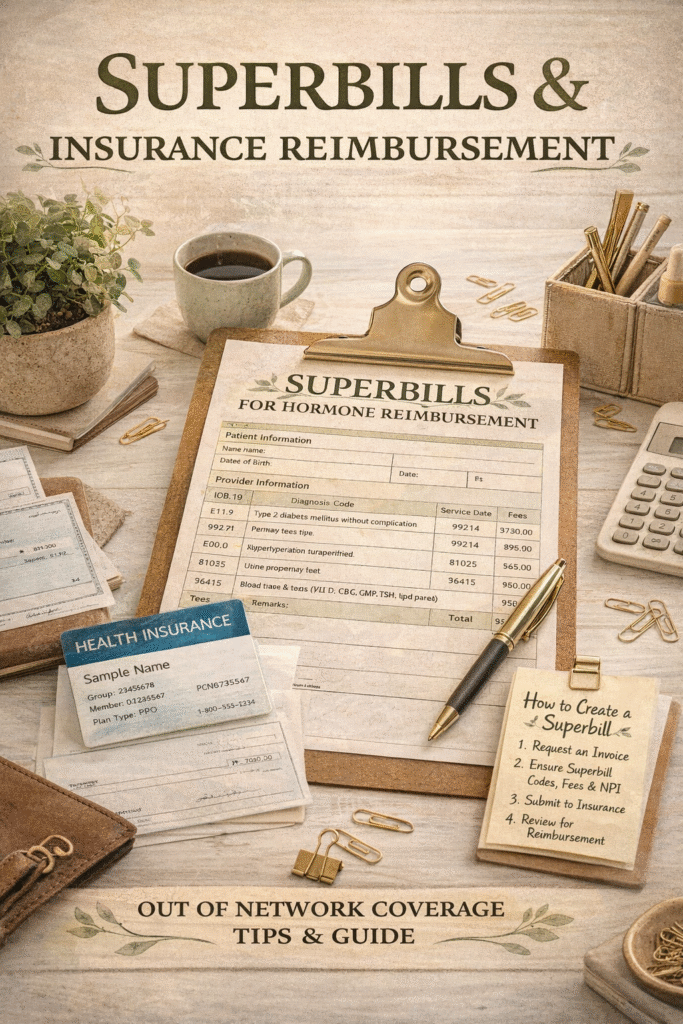
A superbill is a detailed medical receipt that includes all the information an insurance company typically requires for out-of-network reimbursement.
It may include:
Provider credentials and NPI
Practice information
Diagnostic (ICD-10) codes
Service (CPT) codes
Dates of service
Fees paid
You submit the superbill directly to your insurance company, and your insurer determines whether partial reimbursement is available based on your plan.
Important to know:
A superbill is not a guarantee of reimbursement, but many patients receive partial reimbursement, especially if they have out-of-network benefits.
__________________________________________________________________________
Why superbills matter in modern healthcare
Insurance-based healthcare was designed for:
Acute issues
Short visits
Symptom management
Standardized care
It was not designed for:
Complex hormone transitions
Chronic stress and burnout
Preventive and longevity-focused care
Time-intensive education and coaching
Root-cause medicine
Superbills create a bridge between:
The care you want
And the insurance benefits you do have
They give patients flexibility without requiring providers to practice medicine dictated by insurance rules.
__________________________________________________________________________
How superbills support patient-driven healthcare
Superbills shift power back to the patient.
Instead of insurance companies deciding:
Who you can see
How long you get
What problems are “worth” addressing
You get to:
Choose your provider
Choose a model of care that aligns with your goals
Pay for care transparently
Seek reimbursement afterward if your plan allows
This model prioritizes health outcomes, not billing efficiency.
__________________________________________________________________________
Why this works especially well for women in perimenopause & menopause
Midlife women often:
See multiple providers without clear answers
Are told symptoms are “normal” or “just stress”
Need more time, nuance, and personalization
Fall outside rigid insurance treatment pathways
Care during perimenopause and menopause frequently includes:
Detailed history-taking
Education and coaching
Functional lab interpretation
Lifestyle and nervous system support
Individualized hormone management
These services are often difficult to deliver well within insurance constraints—but superbills allow women to pursue this care anyway.
__________________________________________________________________________
How superbills are used at Antigravity Wellness
At Antigravity Wellness:
We are a self-pay practice
We do not bill insurance directly
We do provide superbills upon request for eligible services
Many of our patients have successfully used superbills to receive:
Partial reimbursement
Application toward out-of-network deductibles
Flexible use of their insurance benefits
This approach allows us to:
Spend more time with patients
Practice medicine without insurance interference
Focus on outcomes, education, and prevention
Maintain transparent pricing
__________________________________________________________________________
What superbills don’t do (important clarity)
Superbills:
❌ Do not guarantee reimbursement
❌ Do not override your insurance plan rules
❌ Do not replace HSA/FSA benefits
But they do:
Provide documentation
Create reimbursement opportunities
Expand access to care
Increase affordability for many patients
Think of superbills as an option—not a promise—and often a very helpful one.
__________________________________________________________________________
Superbills + HSA/FSA = maximum flexibility
Many patients use a combined strategy:
Pay for care using HSA or FSA funds
Submit a superbill to insurance
Receive partial reimbursement when available
This layered approach gives women:
Financial flexibility
Predictable access to care
Less dependence on insurance approval
It’s one of the smartest ways to navigate modern healthcare.
__________________________________________________________________________
Why we offer superbills (and always will)
At Antigravity Wellness, we believe:
Women deserve time, education, and partnership
Healthcare should be proactive—not crisis-driven
Insurance should not dictate the quality of care you receive
Patients should have choices
Superbills allow us to stay aligned with our values while helping patients make care more accessible.
__________________________________________________________________________
Are We a Good Fit?
If you’re considering care at Antigravity Wellness and wondering:
Whether superbills apply to you
If your insurance offers out-of-network benefits
How to combine superbills with HSA/FSA funds
The best next step is clarity.
We invite you to complete our Readiness Questionnaire, which helps determine:
Whether our model of care aligns with your goals
What level of support is appropriate
Whether now is the right time to begin
👉 Take the Readiness Questionnaire to explore next steps.
__________________________________________________________________________
References
1. Centers for Medicare & Medicaid Services (CMS). Action Plan: Bill with an out-of-network provider. https://www.cms.gov/medical-bill-rights/help/plan/insurance-provider-out-of-network
2. American Medical Association (AMA).
CPT® Code Set and Medical Billing Documentation Standards.
— Establishes standards for coding and documentation used on superbills. https://www.ama-assn.org/topics/cpt-codes
3.Consumer-Directed Health Care: Will It Improve Health System Performance? https://pmc.ncbi.nlm.nih.gov/articles/PMC1361064/
4. Buntin, M. B., et al. (2011).
Consumer-directed health care: Early evidence about effects on cost and quality.
Health Affairs, 30(6), 1039–1047. https://pubmed.ncbi.nlm.nih.gov/17062591/
5. Rosenbaum, S. (2011).
The patient protection and affordable care act: Implications for public health policy and practice.
Public Health Reports, 126(1), 130–135. https://pmc.ncbi.nlm.nih.gov/articles/PMC3001814/
__________________________________________________________________________
Medical Disclaimer
This article is for educational purposes only and is not intended to provide medical, legal, or insurance advice. Reimbursement for out-of-network services varies by insurance plan. Superbills do not guarantee reimbursement. Patients are responsible for confirming benefits with their insurance carrier. Medical services should always be discussed with a qualified healthcare professional.