


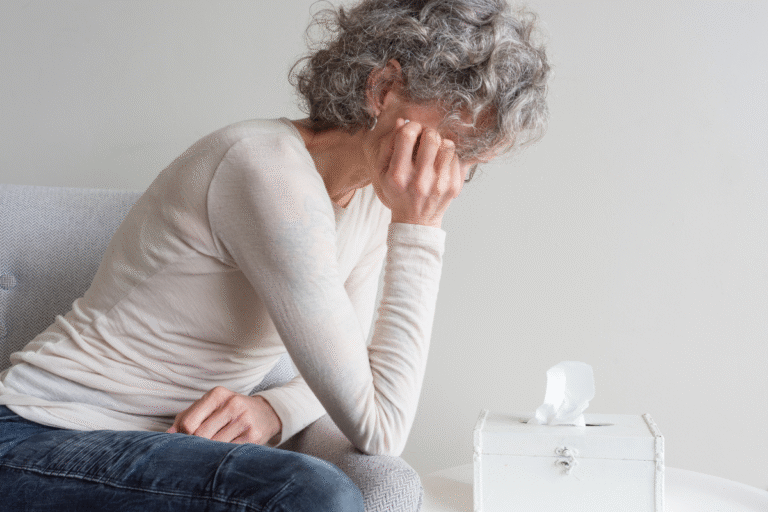
For many, the holiday season is painted as a time of joy—family gatherings, twinkling lights, comforting traditions, delicious food, and warm drinks shared on cold winter nights. But for many midlife women, the holidays can also quietly magnify something far less talked about: grief.
Grief doesn’t follow a calendar. It doesn’t politely pause for Christmas or New Year’s. And it certainly doesn’t disappear just because others expect us to be cheerful.
If the darker nights of winter stir sadness, memories, or an ache you can’t quite name—you are not alone. And you are not doing it wrong.
Why the Holidays Can Feel Heavier in Midlife
By midlife, none of us have escaped loss. We may be grieving:
- The death of a parent, partner, friend, or child
- Estranged relationships or family fractures
- A divorce or loss of identity
- Health changes—our own or someone we love
- The loss of youth, fertility, or the version of ourselves we once knew
The holidays often act as emotional amplifiers. Traditions remind us of who is missing. Quiet winter evenings leave more room for reflection. And expectations—both internal and external—can make grief feel isolating.
Interestingly, this season is also associated with increased physical stress. Studies have consistently shown higher rates of cardiovascular events, including heart attacks, during the winter months and around major holidays. Several theories may explain this:
- Increased emotional stress and loneliness
- Disrupted sleep and routines
- Changes in diet and alcohol intake
- Reduced physical activity
- Cold weather and reduced sunlight affecting mood and circadian rhythms
For women in perimenopause and menopause—already navigating hormonal shifts that affect mood, sleep, stress resilience, and inflammation—this combination can be particularly potent.
Grief Has No Expiration Date
One of the most harmful myths about grief is that we are supposed to “get over it.”
Grief expert David Kessler reminds us that grief is not something we complete or finish. It is something we learn to carry. Loss—whether recent or decades old—can resurface during certain seasons of life, and that does not mean you are weak or regressing.
Grief is not linear.
Grief is not tidy.
Grief does not care how much time has passed.
And importantly: no one else gets to decide how you should be experiencing it—including that inner critic that whispers you should be “past this by now.”
I highly recommend David Kessler’s work, including his book Finding Meaning, as well as his interview on the Mel Robbins Podcast. Many women also find it helpful to access his book via Audible, Kindle, or paperback—whatever meets you where you are.
The Often-Unspoken Grief of the Menopause Transition
Perimenopause and menopause can also bring their own, quieter forms of grief:
- Grieving fertility or reproductive years
- Grieving changes in energy, sleep, or body composition
- Grieving the loss of a sense of predictability or control
- Grieving the version of yourself that felt younger or more invincible
Even if these losses don’t feel as “big” as others, they are still valid. Loss is not a competition.
Acknowledging this grief—rather than minimizing it—can be a powerful step toward healing.
Grief Expands Our Capacity for Joy
One of the most profound truths about grief is this:
Grief increases our capacity for sadness—and also our capacity for joy, love, connection, and meaning.
When we allow grief to move through us rather than suppress it, we create space. Space to love more deeply. Space to feel joy without guilt. Space to connect without fear.
Holding grief tightly, pushing it down, or pretending it isn’t there often keeps us stuck. Allowing it—gently, compassionately—can be what ultimately allows us to live more fully.
Asking for Help Is a Strength
If there is one message I want every woman to hear during this season, it’s this:
You do not have to do this alone.
Support can look like:
- Grief counseling or therapy
- Support groups (in person or virtual)
- Faith-based or community groups
- Trusted friends who can sit with you without trying to fix you
And for women navigating hormonal transitions, connecting with others who understand what your body and mind are going through can be incredibly grounding.
Our Perimenopause & Menopause Facebook Community is one such place—where women can share, listen, and be reminded that they are not alone in what they’re feeling. Click here to join our community.
A Gentle Reminder
You are not broken.
You are not behind.
You are not grieving “wrong.”
Grief is a reflection of love—and love doesn’t have an endpoint.
Medical Disclaimer
This article is for educational and informational purposes only and is not intended to diagnose, treat, or replace medical or mental health care. If you are experiencing persistent depression, anxiety, thoughts of self-harm, or worsening physical symptoms, please seek care from a qualified healthcare provider or mental health professional.
Helpful Grief Resources
- David Kessler – Finding Meaning and online grief resources
- Mel Robbins Podcast – Interview with David Kessler on grief and meaning
- GriefShare – Community-based grief support groups
- Psychology Today – Therapist and grief counselor directory
- National Alliance on Mental Illness (NAMI) – Support and education resources
Ready for Support in Your Hormone Health Journey?
If you are navigating perimenopause or menopause and feel that hormonal changes may be amplifying stress, grief, mood changes, sleep disruption, or physical symptoms—and you live in Washington or Oregon—we’re here to help.
👉 Take our Readiness Questionnaire to explore your next steps and see if comprehensive, compassionate hormone care through Antigravity Wellness is right for you.
You deserve support—in every season of life.