

Sarah is 44. She eats well, stays active, and has always tried to “do the right things” for her health.
A few months ago, she slipped while stepping off a curb. It wasn’t a dramatic fall, but she caught herself with her hand—and broke her wrist.
At her follow-up appointment, she was told something she didn’t expect:
“You may already have bone loss.”
Sarah was shocked. She had been taking calcium for years. She thought she was doing everything right.
What she didn’t realize—and what many women aren’t told—is that bone health is about much more than calcium.
What This Is
Osteoporosis is a condition where bones become weaker, less dense, and more likely to break.
It affects both men and women, but it is especially common in women over the age of 50 due to hormonal changes. In fact, 1 in 2 women will experience an osteoporosis-related fracture in their lifetime.
Bone is living tissue. It is constantly being broken down and rebuilt. When the body breaks down more bone than it builds, bones become fragile over time.
This matters because fractures are not just injuries—they can lead to pain, loss of independence, and long-term health decline.
Why It Happens
Bone loss does not happen overnight. It is the result of several factors working together over time.
One of the biggest drivers is hormonal change.
Estrogen plays a protective role in bone health. It helps keep the balance between bone breakdown and bone building. As estrogen declines during perimenopause and menopause, bone breakdown begins to outpace bone formation.
Another major factor is muscle loss.
Muscle and bone work together. When muscles contract, they pull on bone and signal it to stay strong. This process is called mechanotransduction, which simply means the body responds to movement by strengthening the areas being used.
When muscle mass decreases, that signal weakens—and bone density follows.
Nutrition also plays a key role.
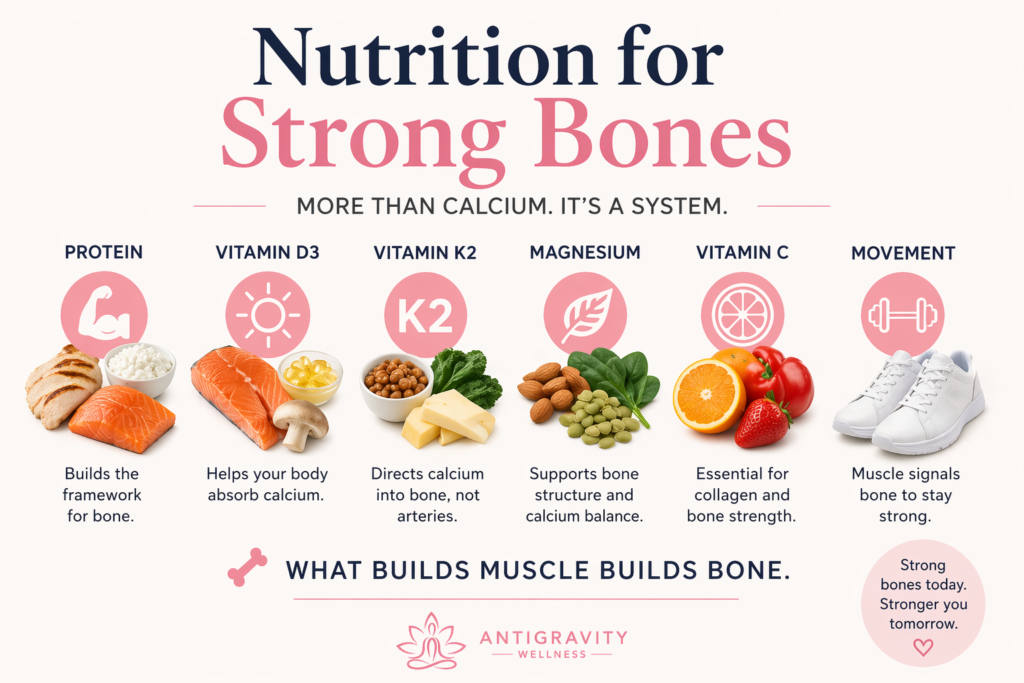
Bone is not just made of calcium. It requires:
- Protein (to build structure)
- Vitamin D (to absorb calcium)
- Vitamin K2 (to direct calcium into bone)
- Magnesium and other nutrients (to support the process)
Without these, the system does not work effectively.
Symptoms
Osteoporosis is often called a “silent disease” because many people have no symptoms until a fracture occurs.
However, some early signs can include:
- Loss of height over time
- Back pain
- Changes in posture
- Weakness or decreased strength
- Fractures from minor falls or injuries
What Else Could It Be
Not all bone loss is simple age-related osteoporosis.
Other conditions can contribute, including:
- Thyroid disorders
- Vitamin D deficiency
- Chronic inflammation
- Autoimmune conditions
- Long-term steroid use
Red flags that should prompt further evaluation include:
- Fracture from a minor fall
- Rapid height loss
- Severe or persistent back pain
- Family history of osteoporosis
Evaluation
If bone loss is suspected, a provider may recommend further evaluation.
This can include:
- A detailed health history (nutrition, activity, family history)
- Blood work (vitamin D, calcium, thyroid, markers of bone health)
- Bone density testing (DEXA scan)
A DEXA scan measures bone mineral density and helps determine whether someone has normal bone density, osteopenia (early bone loss), or osteoporosis.
Treatment Options
Treatment for bone health is not just about one intervention—it is about building a system that supports strong bones.
Nutrition is foundational.
Adequate protein intake is critical because it forms the structural framework of bone. A practical target is around 1 gram per pound of ideal body weight, with higher intake for active individuals.
Calcium is still important, with a goal of 1,000–1,200 mg per day, preferably from food sources like dairy, leafy greens, and fish with bones.[2]
Vitamin D3 helps the body absorb calcium. Many people, especially in the Pacific Northwest, require supplementation to reach optimal levels. In clinical practice, levels between 60–80 ng/mL are often targeted for bone health.
Vitamin K2 helps direct calcium into bone instead of arteries, supporting both bone and cardiovascular health.
Magnesium, vitamin C, iron, and boron all play supporting roles in bone formation and metabolism.
Movement is equally important.
Resistance training helps preserve muscle and stimulates bone to stay strong. This is where the concept applies:
What builds muscle builds bone.
Lifestyle factors also matter.
Avoiding chronic under-eating, limiting alcohol, managing stress, and staying active all support long-term bone health.
In some cases, hormone therapy or medications may be appropriate and should be discussed with a qualified provider.
Case Study
“Melissa,” age 52, came in feeling frustrated with weight gain and fatigue. She had never considered her bone health.
Her evaluation showed:
- Low vitamin D
- Early osteopenia
- Low protein intake
- Minimal resistance training
Over the next 6 months, we focused on:
- Increasing protein intake
- Starting a strength training program
- Optimizing vitamin D and nutrients
- Improving overall lifestyle habits
At follow-up, she reported:
- Increased strength
- Improved energy
- Better body composition
Most importantly, she was no longer just maintaining—she was actively building her health.
Key Takeaways
Bone health is not just about calcium.
It is a system that requires:
- Protein
- Nutrients
- Muscle
- Movement
What builds muscle builds bone.
And prevention starts earlier than most people think.
Your Next Step
If you are living in Washington or Oregon and are interested in advanced hormone and metabolic care, Antigravity Wellness offers a hybrid telemedicine practice designed for men and women looking for root-cause solutions.
Take our readiness questionnaire to see if Antigravity Wellness is a good fit for you.
We also offer monthly Body Composition Analysis at our in-person Kennewick location, helping you understand your lean mass, body fat, and long-term bone health strategy.
References
- Bone Health & Osteoporosis Foundation. https://www.bonehealthandosteoporosis.org/patients/what-is-osteoporosis/
- National Institutes of Health, Office of Dietary Supplements. Calcium Fact Sheet. https://ods.od.nih.gov/factsheets/Calcium-HealthProfessional/
- Muñoz-Garach, A., et al. Nutrients and Bone Health. https://pmc.ncbi.nlm.nih.gov/articles/PMC7400143/
- Rizzoli, R., et al. Nutrition and Osteoporosis Prevention. https://pmc.ncbi.nlm.nih.gov/articles/PMC11499541/
- Tripkovic, L., et al. Vitamin D2 vs D3. https://pubmed.ncbi.nlm.nih.gov/22552031/
Medical Disclaimer
This article is for educational purposes only and is not intended to diagnose, treat, or replace medical advice from your healthcare provider. Always consult your qualified healthcare professional before making changes to your medications, supplements, or treatment plan. Individual needs vary, and recommendations should be personalized. Antigravity Wellness provides care for eligible patients in Washington and Oregon through a hybrid telemedicine model.