

“I swear I’m doing everything right.”
She sat across from me, frustrated and exhausted.
“I’m eating the same as I always have. I’m working out. But now everything is going straight to my stomach—and the scale won’t budge.”
If you’re reading this, you may have had a similar thought.
What worked in your 20s and 30s suddenly feels ineffective. The effort is there—but the results are not.
And somewhere along the way, you’ve probably been told one of two things:
“It’s just calories in, calories out.”
or
“Calories don’t matter anymore—it’s all hormones.”
The truth is, neither of these is fully correct.
Calories Still Matter—But the System Has Changed
At its core, body weight is still governed by energy balance. When your body takes in more energy than it uses, it stores that energy. When it uses more than it takes in, it draws from stored energy.¹
That principle does not disappear in menopause.
However, the system you are working within changes—and that is where most women run into frustration.
What Actually Changes in Menopause
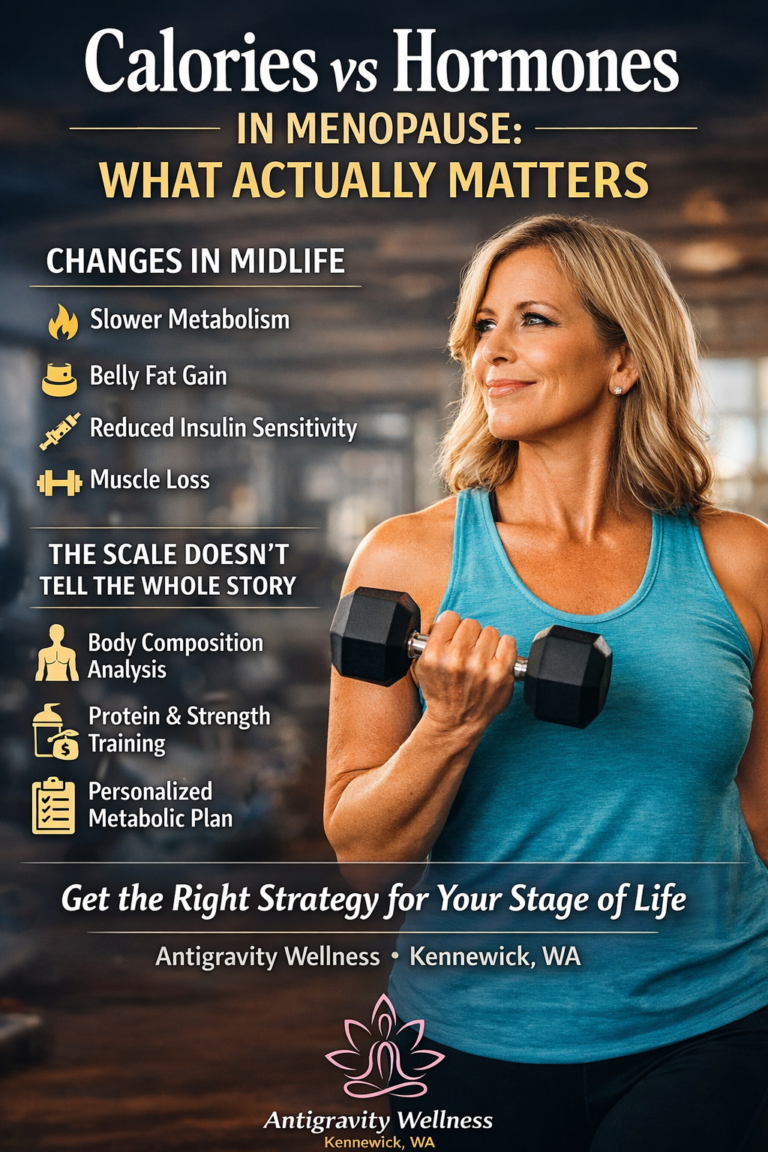
1. Metabolism Becomes More Dependent on Lifestyle
Many women feel like their metabolism has “slowed down overnight.” In reality, research shows that metabolism remains relatively stable through midlife and declines more gradually than expected.²
What often changes instead:
- Lean muscle mass decreases
- Daily movement declines
- Recovery becomes more important
These factors lower total energy expenditure, meaning your previous routine may no longer create the same results.
2. Fat Distribution Shifts Toward the Abdomen
One of the most noticeable changes is where fat is stored.
As estrogen declines, the body becomes more prone to storing fat centrally, particularly as visceral fat around the abdominal organs.³
This is why many women notice:
- Increased belly fat
- A change in body shape
- Clothes fitting differently—even if weight is stable
This shift can occur without major changes on the scale, which is why body composition becomes far more important than weight alone.
3. Insulin Sensitivity Changes
Estrogen plays a key role in metabolic regulation. As levels decline, the body often becomes less insulin sensitive, which can make blood sugar regulation more challenging and increase the tendency to store energy.⁴
This does not mean calories stop mattering—it means the body may handle them differently.
4. Muscle Loss Becomes Easier Without Intervention
Menopause is associated with an increased risk of losing lean muscle mass, especially without adequate protein intake and resistance training.⁵
This matters because muscle:
- Supports metabolism
- Improves insulin sensitivity
- Helps maintain strength and long-term health
Without a strategy to preserve it, fat loss becomes more difficult and body composition can worsen—even if weight stays the same.
Case Study: When the Scale Was Misleading
A 46-year-old patient came to Antigravity Wellness feeling stuck.
She had been:
- Exercising regularly
- Eating what she believed was a healthy diet
- Maintaining the same weight for over a year
Her concern was simple: “Why is my body changing if my weight isn’t?”
We performed a Body Composition Analysis.
What we found:
- Decrease in lean muscle mass
- Increase in body fat percentage
- Elevated visceral fat
Despite a stable weight, her body composition had shifted significantly.
We implemented:
- Increased protein intake
- A structured resistance training program
- Slight adjustments to caloric intake
- Daily step goals
Within 12 weeks:
- Body fat decreased
- Lean muscle increased
- Visceral fat improved
- Energy and strength significantly increased
The scale moved minimally—but her health markers and physique changed dramatically.
Where Most Advice Goes Wrong
You may have heard statements like:
“Your deficit is no longer a deficit.”
“Calories don’t work anymore.”
“It’s all hormones now.”
These statements take real physiological changes and stretch them into misleading conclusions.
A more accurate understanding is:
- Your calorie needs may change
- Your body’s response to food may change
- Hormones influence how your body functions
But energy balance still applies, and your body is not broken.
What Actually Works in Midlife
The goal is not to choose between calories or hormones—but to work with both.
Prioritize Protein
Higher protein intake supports lean muscle and metabolic health. Aim for 1 gram per lb of ideal lean body weight in perimenopause, and 1.2 grams per lb of ideal lean body weight after menopause.⁶
Incorporate Resistance Training
Strength training helps preserve muscle and improve insulin sensitivity.⁷
Use Strategic Calorie Adjustments
Avoid extreme restriction. Sustainable, moderate adjustments are more effective long term.
Increase Daily Movement
Non-exercise activity significantly impacts total energy expenditure.⁸
Consider Hormone Optimization When Appropriate
For some women, hormone therapy can support metabolic health and body composition when medically indicated.⁹
Why the Scale Isn’t Enough
In midlife, the scale alone does not tell the full story.
You can:
- Maintain weight
- Lose muscle
- Gain visceral fat
And still feel like your body is “working against you.”
This is why understanding your body composition is critical.
Take the Guesswork Out of Your Strategy
At Antigravity Wellness in Kennewick, WA, we offer Body Composition Analysis visits to give you a clear picture of what is actually happening inside your body.
This includes:
- Lean muscle mass
- Body fat percentage
- Visceral fat
- Trends over time
You also have the option to upgrade to a Metabolic Strategy Protocol, where we create a personalized plan based on your results, symptoms, and goals.
This allows you to stop guessing and start making targeted, effective changes.
Ready to Understand Your Body at a Deeper Level?
If you are feeling stuck and want clarity on what your body actually needs, this is the next step.
Schedule your Body Composition Analysis visit in Kennewick, WA, with the option to add your Metabolic Strategy Session for a personalized plan designed for this stage of life.
Medical Disclaimer
This content is for informational and educational purposes only and is not intended as medical advice, diagnosis, or treatment. Always consult with a qualified healthcare provider before making changes to your diet, exercise, medications, or health regimen. Individual needs vary, and recommendations should be personalized based on your medical history and goals.
References
- Hall KD et al. Energy balance and its components. https://www.ncbi.nlm.nih.gov/books/NBK279077/
- Pontzer H et al. Daily energy expenditure through the human life course. https://www.science.org/doi/10.1126/science.abe5017
- Toth MJ et al. Menopause-related changes in body fat distribution. https://pmc.ncbi.nlm.nih.gov/articles/PMC9258798/
- Mauvais-Jarvis F. Estrogen and androgen receptors in metabolic regulation. https://pmc.ncbi.nlm.nih.gov/articles/PMC5460681/
- Collins BC et al. Estrogen, skeletal muscle, and aging. https://pmc.ncbi.nlm.nih.gov/articles/PMC4242477/
- Phillips SM et al. Protein requirements and muscle mass. https://pmc.ncbi.nlm.nih.gov/articles/PMC6566799/
- Westcott WL. Resistance training and metabolic health. https://pmc.ncbi.nlm.nih.gov/articles/PMC6279907/
- Levine JA. Non-exercise activity thermogenesis. https://pubmed.ncbi.nlm.nih.gov/12468415/
- Davis SR et al. Menopausal hormone therapy and metabolic health. https://pmc.ncbi.nlm.nih.gov/articles/PMC9178928/
Dr. Nicole Smith, DNP, FNP-C, ONP-C, MSCP, CPT
Antigravity Wellness