“I’m exhausted… but I can’t sleep.”
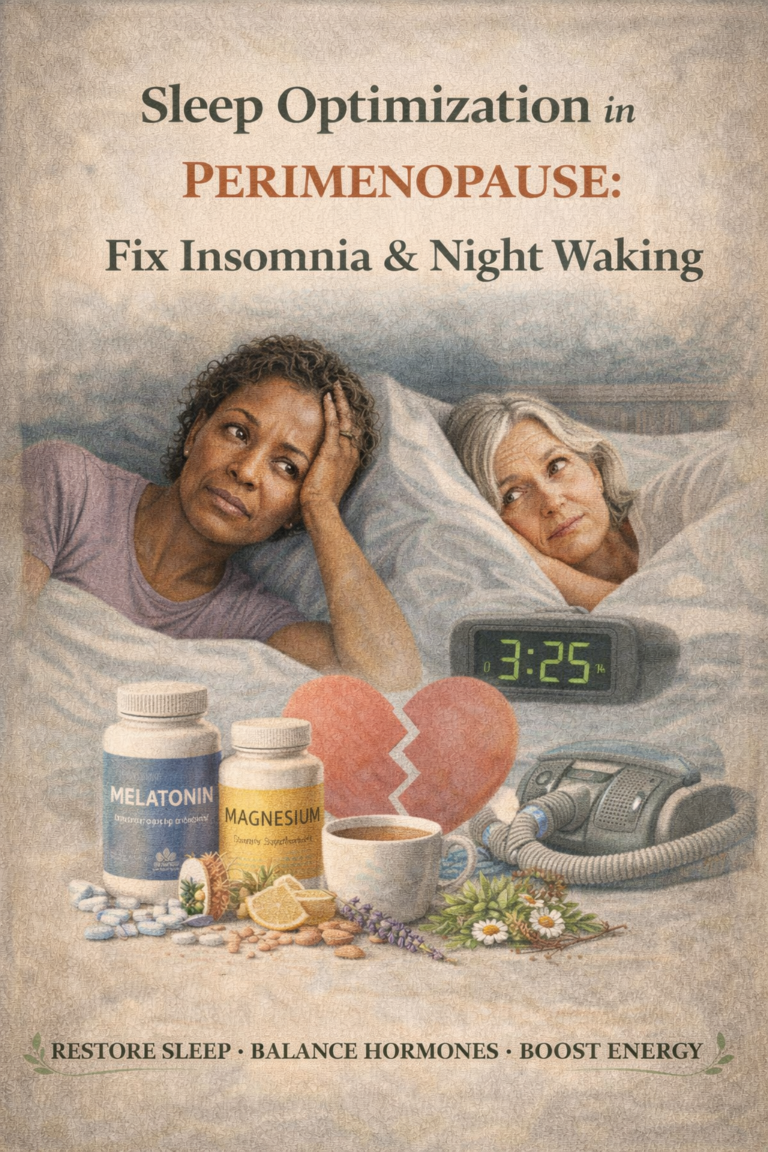
She told me she was doing everything right.
No caffeine after noon. Calm evenings. Magnesium at night.
Still—she laid awake for hours. Or woke up at 2–3 AM, heart racing, mind wide open.
Her doctor said, “That’s just part of getting older.”
But her body was saying something very different.
If this sounds like you, you’re not broken—and you’re not alone.
Why Sleep Breaks in Perimenopause
Sleep problems are often one of the first signs of perimenopause.
Not the last.
Here’s why 👇
1. Progesterone Drops
Progesterone is a hormone that helps calm the brain and nervous system.
As it declines:
- Falling asleep gets harder
- Sleep becomes lighter
- Night waking increases
2. Cortisol Rises at the Wrong Time
Cortisol is your stress hormone.
It should be high in the morning and low at night.
In perimenopause, cortisol often:
- Spikes at night
- Wakes you between 2–4 AM
- Leaves you “tired but wired”
3. Blood Sugar Becomes Less Stable
If blood sugar drops overnight:
- Cortisol rises to “save” you
- Your brain wakes you up
This is very common in midlife women—even those eating “healthy.”
Why Sleep Aids Often Don’t Work
Many women try:
- Melatonin
- Magnesium
- CBD
- Sleep teas
These can help—but only if hormones and stress chemistry are balanced.
If cortisol is high, melatonin (your sleep hormone) can’t do its job.
This is why sleep supplements alone often fail.
A Real-Life Case Study
Patient: 46-year-old woman, busy professional, active, eating well
Main complaint:
- Trouble falling asleep
- Waking nightly at 2–3 AM
- Morning fatigue and brain fog
What we found:
- Low progesterone
- Elevated nighttime cortisol
- Mild blood sugar instability
Our approach:
- Hormone support tailored to her labs
- Nutrition changes to stabilize nighttime blood sugar
- Nervous system regulation strategies
- Targeted supplements (not a long list)
Results (within 6–8 weeks):
- Falling asleep within 20 minutes
- Sleeping through the night most nights
- Waking up feeling rested again
How Antigravity Wellness Helps
We don’t treat sleep as an isolated problem.
Our care packages focus on:
- Hormone balance (estrogen, progesterone, cortisol)
- Stress physiology (how your nervous system responds to life)
- Nutrition & blood sugar support
- Personalized plans based on symptoms, labs, and goals
No guessing. No one-size-fits-all advice.
How to Take the First Step
If sleep is broken, it’s often a sign your body needs deeper support.
Your first step is simple: 👉 Complete our Readiness Questionnaire
This helps us understand:
- Your symptoms
- Your health history
- Whether our care is the right fit for you
From there, we guide you to the next best step.
Key Takeaways
- Sleep problems in perimenopause are hormone-driven, not personal failure
- Progesterone, cortisol, and blood sugar all affect sleep
- Supplements alone rarely fix the root issue
- A whole-body, personalized approach works best
You deserve real rest—not just survival sleep.
Medical References
- Baker FC, et al. Sleep and menopause. Endocrine Reviews. https://pubmed.ncbi.nlm.nih.gov/30098758/
- Kravitz HM, et al. Sleep difficulty in women at midlife. Menopause. https://pubmed.ncbi.nlm.nih.gov/12544673/
- Leproult R, Van Cauter E. Role of sleep and circadian rhythms in hormonal regulation. Endocrine Development. https://pubmed.ncbi.nlm.nih.gov/19955752/
- Gold EB, et al. The Study of Women’s Health Across the Nation (SWAN). https://ajph.aphapublications.org/doi/full/10.2105/AJPH.2005.066936
- Nora A O’Byrne, et al. Sleep and Circadian Regulation of Cortisol. https://pmc.ncbi.nlm.nih.gov/articles/PMC8813037/
Medical Disclaimer
This blog is for educational purposes only and does not replace medical advice. It is not intended to diagnose, treat, or cure any condition. Always consult your qualified healthcare provider before making changes to medications, supplements, or treatment plans.