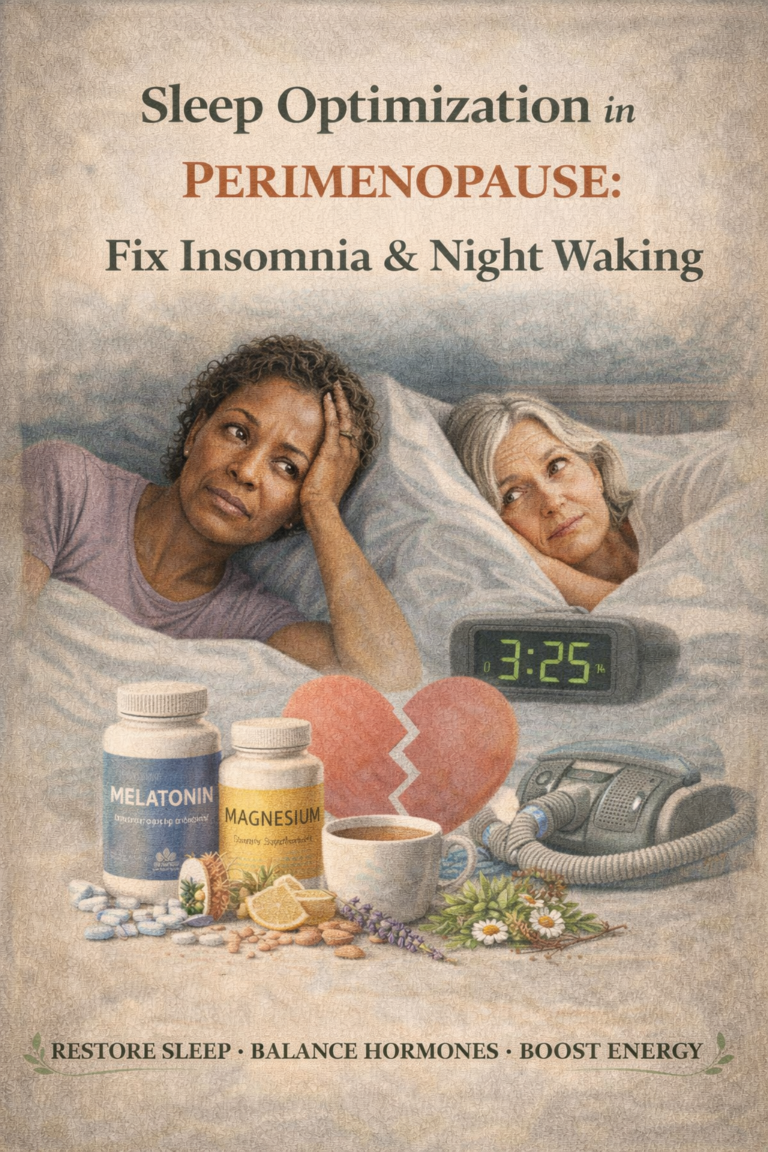

You wake up at 3 AM—again. Your heart is racing, you’re drenched in sweat, and your mind immediately starts spiraling through tomorrow’s to-do list. You tell yourself you’ll deal with your health “when things calm down.” But things never calm down. And meanwhile, you’re gaining weight, losing sleep, and feeling like you’re losing your mind.
Sound familiar?
Here’s what most women don’t know: Your stress and mindset are making every perimenopause symptom worse. And waiting to deal with it isn’t helping—it’s hurting.
In this post, I’m breaking down the science behind the mindset-hormone connection and sharing 7 powerful, evidence-based practices to support your hormones, lower cortisol, and ease your symptoms—starting today.
Meet Sarah: A Story You’ll Recognize
Sarah came to me at 47, absolutely exhausted. She was waking up 3-4 times per night, had gained 20 pounds she couldn’t lose no matter what she tried, felt anxious and irritable all the time, experienced hot flashes multiple times per day, and told me she felt like she was “losing her mind.”
Her primary care doctor had said, “It’s just perimenopause. Here’s an antidepressant.”
But Sarah knew there had to be more to the story. She was right.
After implementing the mindset practices I’m sharing in this post—along with personalized functional medicine care and hormone support—Sarah is now sleeping 7-8 hours per night, has lost 15 pounds, reports significantly reduced anxiety, and her hot flashes have been cut in half.
Same body. Same hormones. Different mindset.
And you can experience this transformation too.
The Problem: How Stress and Mindset Impact Your Hormones
Here’s what’s happening in your body during perimenopause:
Your ovaries are producing less progesterone. Progesterone is your calming, sleep-supporting, anxiety-reducing hormone. When it drops, you feel the effects immediately—disrupted sleep, increased anxiety, weight gain, and worsening PMS symptoms.
Now add chronic stress to the equation.
When you’re stressed—whether from work deadlines, family responsibilities, negative self-talk, or scrolling social media comparing yourself to other women—your body releases cortisol.
Cortisol is your stress hormone. In small doses, it’s helpful. But when cortisol stays elevated (chronic stress), it:
- Blocks progesterone production – making your symptoms worse
- Disrupts your sleep – keeping you in light sleep, waking you up at night
- Increases belly fat storage – especially around your midsection
- Raises blood sugar – making weight loss nearly impossible
- Triggers inflammation – worsening joint pain, brain fog, and fatigue
- Weakens your immune system – leaving you more susceptible to illness
In other words: You can’t hate yourself into health.
Chronic stress, negative self-talk, comparison, perfectionism, and all-or-nothing thinking keep your body in fight-or-flight mode—elevating cortisol, blocking progesterone, and making every perimenopause symptom worse.
The Good News: Your Body Responds to Mindset Shifts
Here’s what happens when you shift your mindset and manage stress:
✅ Cortisol drops – signaling safety to your body
✅ Progesterone production improves – supporting sleep and mood
✅ Sleep quality increases – allowing your body to heal and restore
✅ Weight loss becomes easier – as cortisol-driven fat storage decreases
✅ Symptoms ease – hot flashes, anxiety, brain fog, and fatigue improve
Your thoughts matter. Your stress matters. Your mindset matters.
And the practices I’m sharing below are the same ones I teach my patients—and they work.
7 Science-Backed Practices to Support Your Hormones Through Mindset
Practice #1: Morning Gratitude Ritual
The Problem: You wake up stressed, immediately thinking about everything that could go wrong. This triggers cortisol release first thing in the morning, setting a stress tone for your entire day.
The Science: Gratitude practices have been shown to lower cortisol levels, activate your parasympathetic nervous system (rest-and-digest mode), and signal safety to your body. Starting your day with gratitude trains your brain to look for the good instead of scanning for threats.
The Practice: Before checking your phone, write down 3 things you’re grateful for.
How to Implement:
- Keep a journal on your nightstand
- Write for just 2 minutes
- Start tomorrow morning
Why it works: Lowers morning cortisol, sets a positive tone for your day, and trains your brain to focus on what’s working instead of what’s not.
Practice #2: The 5-Minute Stress Reset
The Problem: During perimenopause, your ovaries produce less progesterone. When you add chronic stress on top of that, cortisol blocks what little progesterone your body is still making—making your symptoms significantly worse.
The Science: High cortisol blocks progesterone production. Managing stress throughout your day supports progesterone production and helps your body stay in a calm, healing state.
The Practice: Set a timer for 5 minutes. Sit quietly. Breathe deeply (4 counts in, 4 counts hold, 6 counts out). Focus on something you’re grateful for.
How to Implement:
- Schedule it like a doctor’s appointment (non-negotiable)
- Mid-morning, lunch break, or after work
- Close your eyes, put your hand on your heart, breathe
Why it works: Lowers cortisol in real-time, supports progesterone production, activates your parasympathetic nervous system, and reduces anxiety.
Practice #3: Break the Comparison Trap
The Problem: You scroll social media, compare yourself to other women, and think, “What’s wrong with me? Why can’t I look like that? Why is everyone else thriving while I’m struggling?” This triggers a stress response in your body.
The Science: Comparison triggers cortisol release. Your brain perceives comparison as a threat to your social standing and safety. Chronic stress from comparison makes every perimenopause symptom worse.
The Practice: When you catch yourself comparing, pause. Say out loud or in your mind: “Her journey is not my journey. I’m exactly where I need to be.” Then write down one thing you’re proud of about yourself.
How to Implement:
- Notice when comparison thoughts arise
- Interrupt the thought with your affirmation
- Close social media and do something that makes you feel good (walk, call a friend, journal)
Why it works: Interrupts the stress response, lowers cortisol, and brings you back to gratitude and self-compassion.
Practice #4: The Power of “Yet”
The Problem: You talk to yourself in absolutes: “I can’t lose weight.” “I don’t have energy.” “I’m not strong.” Your brain believes you. And nothing changes.
The Science: When you speak in absolutes, you close the door to possibility. Your brain stops looking for solutions. Adding “yet” to the end of negative thoughts opens the door, reminds your brain that you’re capable of change, and lowers stress.
The Practice: Catch negative self-talk. Add “yet” to the end. “I can’t lose weight… yet.” “I don’t have energy… yet.” “I’m not strong… yet.”
How to Implement:
- Notice negative thoughts as they arise
- Reframe with “yet”
- Take one small step in the direction you want to go
Why it works: Opens possibility, rewires your brain for growth, lowers cortisol, and supports healing.
Practice #5: Body Gratitude
The Problem: You look in the mirror and think, “I hate my body. I hate how I look. I hate that I’ve gained weight.” Your body hears that. Your brain perceives self-criticism as a threat and releases cortisol.
The Science: You cannot hate yourself into health. Self-criticism triggers the same stress response as external threats. Self-compassion, on the other hand, activates your relaxation response and supports healing.
The Practice: Every time you look in the mirror, say one thing you’re grateful for about your body.
How to Implement:
- “I’m grateful my legs carry me through my day.”
- “I’m grateful my body is strong and capable.”
- “I’m grateful my arms can hug the people I love.”
- Place your hand on your heart and say, “Thank you, body. I’m here for you.”
Why it works: Lowers cortisol, activates self-compassion, creates a sense of safety in your body, and supports hormone balance.
Practice #6: Bedtime Gratitude Practice
The Problem: You go to bed stressed, worried, replaying everything that went wrong during the day or everything you need to do tomorrow. Cortisol stays elevated. You can’t fall into deep, restorative sleep.
The Science: What you think about before bed directly impacts your sleep quality. Gratitude practices lower cortisol, activate your parasympathetic nervous system, and signal safety to your body—allowing you to fall into deeper sleep.
The Practice: Before bed, write down 3 things you’re grateful for from your day.
How to Implement:
- 30 minutes before bed, dim the lights
- Write down 3 gratitudes (big or small)
- Read them out loud, take a deep breath, and say “thank you”
- Put your phone away and go to sleep
Why it works: Lowers cortisol before bed, improves sleep quality, supports overnight hormone balance and repair.
Practice #7: Progress Over Perfection
The Problem: You start strong on Monday. You slip up on Wednesday. You think, “I ruined it. I’ll just start over Monday.” And you spend the rest of the week completely off track. This cycle keeps you stuck.
The Science: All-or-nothing thinking triggers stress, keeps you in a binge-restrict cycle, raises cortisol, and prevents progress. Progress-focused thinking, on the other hand, lowers stress and builds sustainable momentum.
The Practice: When you make a choice you’re not proud of, pause. Say: “One choice doesn’t define me. I’m getting back on track right now.” Then make one good choice immediately.
How to Implement:
- Notice the slip-up without judgment
- Pause and take a deep breath
- Reframe with your mantra
- Take immediate action (drink water, go for a walk, eat a protein-rich snack)
Why it works: Interrupts the all-or-nothing cycle, lowers stress, builds momentum, and allows your body to heal and balance.
What to Expect: Your Timeline
Week 1: You’ll feel calmer. Your stress response will be less intense. You’ll start catching negative thoughts faster and interrupting them with compassion.
Weeks 2-4: Sleep improves. You’ll have more energy. Symptoms start to ease. You’ll feel more in control of your body and your health.
Months 2-3: Hormones begin to balance. Weight loss becomes easier. Hot flashes decrease. Brain fog lifts. You’ll feel like yourself again.
The key: Consistency over perfection. One practice a day is better than none. Start with one, build from there.
Remember Sarah?
After implementing these 7 practices—along with personalized functional medicine care, hormone replacement therapy, and nutrition coaching—Sarah experienced a complete transformation:
- Sleeping 7-8 hours per night
- Lost 15 pounds in 3 months
- Anxiety significantly reduced
- Hot flashes cut in half
- Feels like herself again
Same body. Same hormones. Different mindset.
And when we added personalized hormone support and nutrition coaching to her mindset work, her results accelerated even more.
Your Action Plan: Start This Week
Step 1: Pick ONE practice from this post.
Step 2: Implement it daily for 7 days.
Step 3: Notice how you feel. Journal your progress.
Step 4: Add another practice next week.
You don’t have to do all 7 at once. Start with one. Build momentum. Be consistent.
Want More Support?
These practices are powerful—but they’re just the beginning.
If you’re ready for personalized support to balance your hormones, lose weight sustainably, improve sleep quality, and feel like yourself again, I’m here to help.
Here’s how to work with me:
Take the Readiness Questionnaire
Find out if Antigravity Wellness is right for you.
Who I serve: Women over 35 in Washington and Oregon navigating perimenopause and menopause.
Final Thoughts
You don’t have to suffer through perimenopause.
Your symptoms are real. Your struggles are valid. And there IS a better way.
Your mindset matters. Your stress matters. Your thoughts matter.
Start with one practice today. Your body will thank you.
To your health,
Dr. Nicole Smith, DNP, ARNP
Founder, Antigravity Wellness
Key Takeaways
✅ Chronic stress elevates cortisol and blocks progesterone production
✅ Negative self-talk, comparison, and perfectionism make symptoms worse
✅ Mindset shifts lower cortisol and support hormone balance
✅ 7 science-backed practices: Morning Gratitude, Stress Reset, Break Comparison, Power of “Yet,” Body Gratitude, Bedtime Gratitude, Progress Over Perfection
✅ Start with ONE practice and build from there
✅ Consistency over perfection
References
- Emmons, R. A., & McCullough, M. E. (2003). Counting blessings versus burdens: An experimental investigation of gratitude and subjective well-being in daily life. Journal of Personality and Social Psychology, 84(2), 377-389. https://pubmed.ncbi.nlm.nih.gov/12585811/
- Pascoe, M. C., Thompson, D. R., Jenkins, Z. M., & Ski, C. F. (2017). Mindfulness mediates the physiological markers of stress: Systematic review and meta-analysis. Journal of Psychiatric Research, 95, 156-178. https://pubmed.ncbi.nlm.nih.gov/28863392/
- Creswell, J. D., et al. (2016). Mindfulness-Based Stress Reduction training reduces loneliness and pro-inflammatory gene expression in older adults. Brain, Behavior, and Immunity, 26(7), 1095-1101. https://pubmed.ncbi.nlm.nih.gov/22820409/
- Neff, K. D., & Germer, C. K. (2013). A pilot study and randomized controlled trial of the mindful self-compassion program. Journal of Clinical Psychology, 69(1), 28-44. https://pubmed.ncbi.nlm.nih.gov/23070875/
Disclaimer: This blog post is for educational purposes only and is not intended to diagnose, treat, cure, or prevent any disease. Always consult with a qualified healthcare provider before making changes to your health regimen. Individual results may vary.