

Several months ago, a woman in her mid-30s came into my clinic exhausted, frustrated, and feeling defeated by her body.
She told me she had struggled for as long as she could remember with central weight gain, intense sugar cravings, fatigue, inflammation, irregular menstrual cycles, and difficulty losing weight despite trying “all the right things.” She had brought these concerns up to providers multiple times over the years, but no one had ever truly evaluated her beyond basic labs or generic lifestyle advice. She had repeatedly been told to “just exercise more,” “reduce stress,” or that this was simply part of aging.
As we dug deeper, the picture became much clearer.
Her labs showed significant insulin resistance and elevated androgen markers. Clinically, she absolutely fit the pattern of what we traditionally call Polycystic Ovary Syndrome (PCOS). Yet when we performed an ultrasound of her ovaries, there were no significant ovarian cysts present.
And that right there highlights one of the biggest problems with the name Polycystic Ovary Syndrome.
Because despite what the name implies, ovarian cysts are not required for the diagnosis at all.1
In fact, many women with the condition never develop what most people think of as “ovarian cysts.” What is often seen on imaging are immature follicles that failed to properly mature and ovulate due to underlying hormonal dysfunction — not dangerous ovarian cysts in the traditional sense.2 The name has confused patients, delayed diagnosis, narrowed research focus, and caused many women to be falsely reassured that they “don’t have PCOS” simply because their ultrasound appeared normal.
That is why the recent announcement that PCOS is being renamed is such a significant step forward in women’s health.
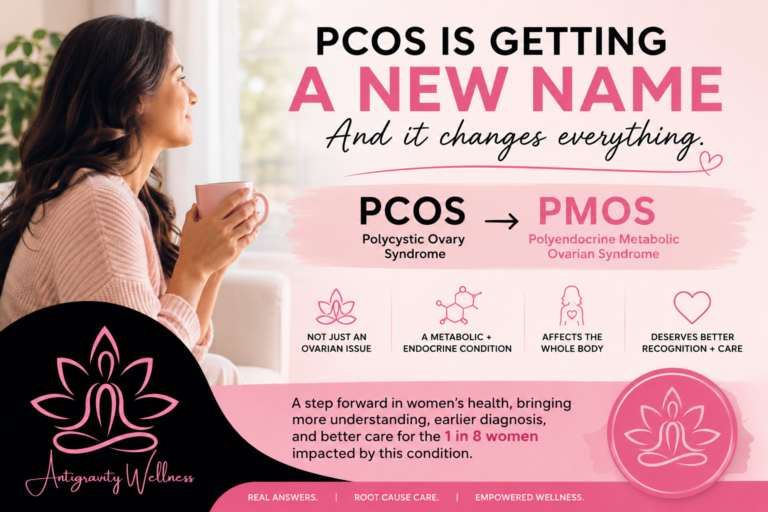
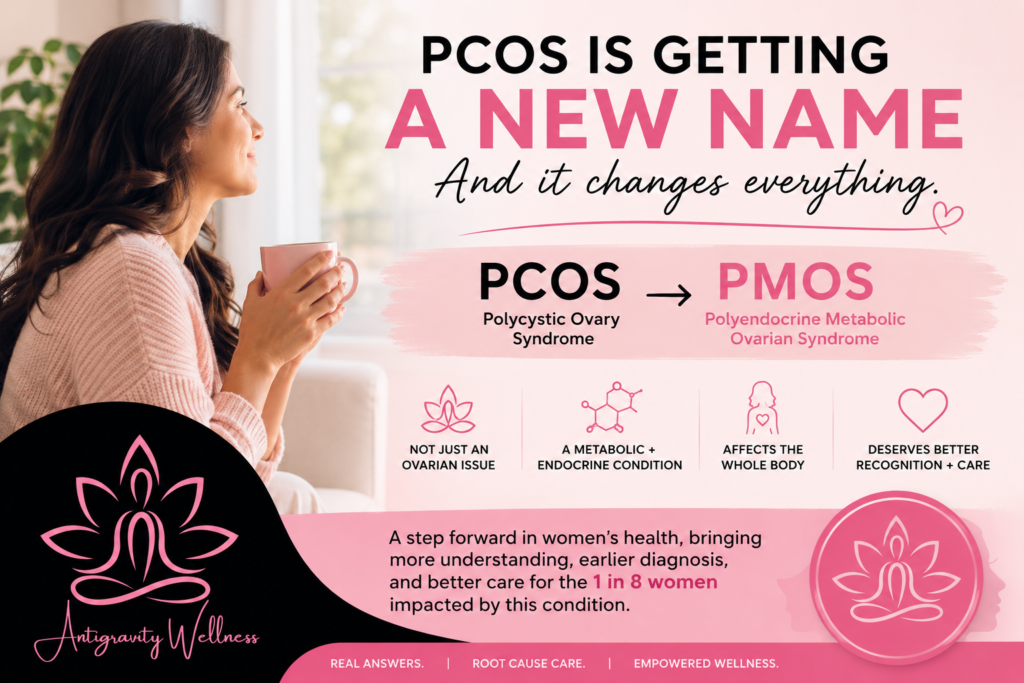
In May 2026, a global coalition of more than 50 professional medical societies and patient advocacy organizations announced that Polycystic Ovary Syndrome (PCOS) will officially transition to a new name: Polyendocrine Metabolic Ovarian Syndrome (PMOS).3 This effort was led by international experts in endocrine and women’s health, including Professor Helena Teede, after more than a decade of collaboration, patient feedback, and research.4
And honestly?
This change is long overdue.
The original name “Polycystic Ovary Syndrome” has never adequately captured what this condition truly is. PCOS is not simply an ovarian disorder. It is a complex endocrine and metabolic syndrome that affects insulin signaling, androgen production, inflammation, cardiovascular risk, reproductive health, mental health, body composition, metabolism, and long-term chronic disease risk.5 The ovaries are only one piece of a much larger systemic condition.
The old terminology created major misunderstandings for both patients and providers. Many women believed the condition only affected fertility or ovarian function. Some providers focused almost entirely on menstrual symptoms while overlooking insulin resistance and metabolic dysfunction. Others dismissed women entirely if ovarian cysts were not present on imaging.6 Meanwhile, the underlying hormonal and metabolic disturbances often continued progressing silently for years.
This matters because PMOS is incredibly common.
Current estimates suggest the condition affects approximately 1 in 8 women globally, impacting more than 170 million women worldwide.3 Yet despite its prevalence, it remains dramatically underdiagnosed. The World Health Organization estimates that up to 70% of women with PCOS remain undiagnosed.7 Research studies have consistently shown that many women experience years, sometimes more than a decade, of delays before receiving proper diagnosis and treatment.8
During those years, many women are told their symptoms are due to stress, lack of discipline, aging, anxiety, depression, poor lifestyle choices, or simply “being a woman.” Meanwhile, insulin resistance, metabolic dysfunction, inflammation, and hormonal imbalances continue worsening beneath the surface.
This delayed diagnosis has serious consequences.
PMOS is associated with increased risks of insulin resistance, prediabetes, type 2 diabetes, metabolic syndrome, hypertension, dyslipidemia, fatty liver disease, infertility, pregnancy complications, cardiovascular disease, endometrial hyperplasia, depression, anxiety, sleep apnea, eating disorders, and chronic inflammation.9 It also commonly impacts quality of life through fatigue, brain fog, acne, hirsutism, hair thinning, weight gain, irregular cycles, and mood disturbances.10
And importantly, PMOS exists on a spectrum.
Not every woman looks the same clinically.
Some women struggle primarily with infertility. Others present with severe insulin resistance and weight gain. Some are lean but metabolically dysfunctional. Some primarily struggle with acne, scalp hair loss, or excess facial hair. Others present with fatigue, inflammation, mood symptoms, or blood sugar instability long before reproductive symptoms become obvious.
This is why the new terminology matters so much.
The new name — Polyendocrine Metabolic Ovarian Syndrome — better reflects the reality that this is a multisystem endocrine-metabolic disorder rather than simply an ovarian condition.3 The updated terminology acknowledges the broader hormonal and metabolic dysfunction involved while helping move medicine away from the misleading emphasis on “cysts.”
Even under the traditional Rotterdam diagnostic criteria, ovarian cysts were never mandatory for diagnosis. A woman could meet criteria with only two of the following three findings:
- irregular or absent ovulation
- clinical or biochemical androgen excess
- polycystic ovarian morphology on ultrasound11
That means a woman could absolutely have the condition without visible ovarian cysts.
Yet countless women have been incorrectly reassured otherwise.
The renaming of PCOS to PMOS is not just about semantics. Words matter in medicine. Names shape research priorities, provider education, public understanding, insurance recognition, diagnostic pathways, and patient validation.
For many women, this change feels deeply validating because it finally acknowledges what they have experienced all along:
This condition affects far more than the ovaries.
It affects the entire body.
Hopefully, this shift will lead to earlier recognition, more comprehensive treatment approaches, better education, reduced stigma, and improved long-term outcomes for millions of women worldwide.
Women deserve better than being dismissed for years.
Women deserve better than having a serious endocrine-metabolic condition reduced to a misleading name centered around ovarian “cysts.”
And this renaming represents an important step toward medicine finally catching up with what patients — and many clinicians — have known for a long time.
Medical Disclaimer
This article is for educational and informational purposes only and does not constitute medical advice, diagnosis, or treatment. Always consult your qualified healthcare provider regarding personal medical concerns, symptoms, medications, supplements, or treatment decisions. Never disregard professional medical advice or delay seeking care because of something you have read online.
References
- Rotterdam ESHRE/ASRM-Sponsored PCOS consensus workshop group. Revised 2003 consensus on diagnostic criteria and long-term health risks related to polycystic ovary syndrome (PCOS). Hum Reprod. 2004 Jan;19(1):41-7. doi: 10.1093/humrep/deh098. PMID: 14688154. https://pubmed.ncbi.nlm.nih.gov/14688154/
- Teede H, Khomami M, Morman R et al. Polyendocrine metabolic ovarian syndrome, the new name for polycystic ovary syndrome: a multistep global consensus process. The Lancet, 2026; 0. https://www.thelancet.com/journals/lancet/article/PIIS0140-6736(26)00717-8/fulltext
- Endocrine Society. (2026, May 12). PCOS name change. https://www.endocrine.org/news-and-advocacy/news-room/2026/pcos-name-change
- The Guardian. (2026, May 12). Polycystic ovary syndrome (PCOS) renamed as polyendocrine metabolic ovarian syndrome (PMOS) in global women’s health shift. The Guardian. https://www.theguardian.com/society/ng-interactive/2026/may/12/polycystic-ovary-syndrome-pcos-new-name-polyendocrine-metabolic-ovarian-syndrome-pmos
- Marron, A. (2026, May 12). PCOS just got a new name. Here’s what to know. Scientific American. https://www.scientificamerican.com/article/pcos-just-got-a-new-name-heres-what-to-know/
- STAT News. (2026, May 12). PCOS now called PMOS: Why experts changed the name to polyendocrine metabolic ovarian syndrome. STAT News. https://www.statnews.com/2026/05/12/pcos-now-called-pmos-polyendocrine-metabolic-ovarian-syndrome/
- Gibson-Helm ME, Lucas IM, Boyle JA, Teede HJ. Women’s experiences of polycystic ovary syndrome diagnosis. Fam Pract. 2014 Oct;31(5):545-9. doi: 10.1093/fampra/cmu028. Epub 2014 Jun 12. PMID: 24925927. https://pubmed.ncbi.nlm.nih.gov/24925927/
- Gibson-Helm M, Teede H, Dunaif A, Dokras A. Delayed Diagnosis and a Lack of Information Associated With Dissatisfaction in Women With Polycystic Ovary Syndrome. J Clin Endocrinol Metab. 2017 Feb 1;102(2):604-612. doi: 10.1210/jc.2016-2963. PMID: 27906550; PMCID: PMC6283441. https://pmc.ncbi.nlm.nih.gov/articles/PMC6283441/
- Oregon Public Broadcasting. (2026, May 12). The condition PCOS is now called PMOS: What to know about the name change and what it means for care. OPB. https://www.opb.org/article/2026/05/12/the-condition-pcos-is-now-called-pmos-what-to-know-about-the-name-change-and-what-it-means-for-care/
- The Guardian. (2026, May 12). Polycystic ovary syndrome (PCOS) to PMOS: Symptoms, meaning, treatment, causes, risk factors, and what the new name means for women’s health. The Guardian. https://www.theguardian.com/society/2026/may/12/polycystic-ovary-syndrome-pcos-pmos-symptoms-meaning-treatment-causes-risk-factors-new-name-explained
- Helena J Teede, et. al., on behalf of the International PCOS Network, Recommendations From the 2023 International Evidence-based Guideline for the Assessment and Management of Polycystic Ovary Syndrome, The Journal of Clinical Endocrinology & Metabolism, Volume 108, Issue 10, October 2023, Pages 2447–2469, https://doi.org/10.1210/clinem/dgad463